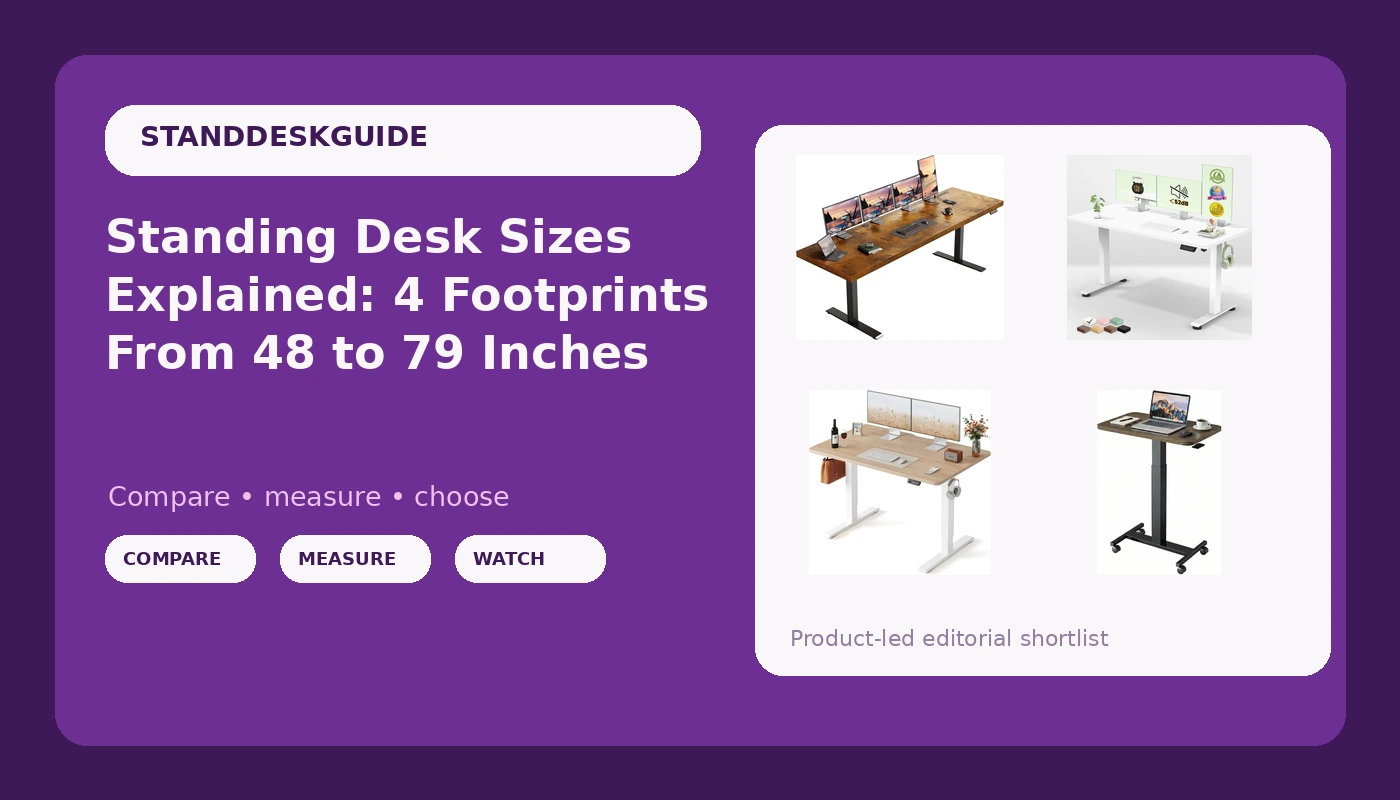
Most people shopping for an electric standing desk start with the brand and the motor, then discover a week later that the desk they picked will not fit the wall they had in mind. Coming at this from the design side, that order is backwards. Electric standing desk sizes are the one spec you cannot upgrade later, because width and depth are fixed by the top and the frame legs, and the room is fixed by your apartment. Get the footprint right and every other decision gets easier.
This guide covers four sizes in the current market: a 48 by 24 inch compact electric desk, a 55 inch model built as a dual-purpose gaming and work surface, a 79 inch executive desk, and a small rolling laptop workstation on lockable casters. The goal is not to crown a winner. It is to help you match a footprint to a room, a monitor setup, and the way you actually spend your day.
Related: Dual Motor vs Single Motor Standing Desks: What Actually Changes →
Quick answer
Match the footprint to the room and the work before you compare anything else. A 48 by 24 inch electric desk fits tight rooms and single-monitor setups, a 55 inch top gives you room for two displays or a monitor plus a laptop, and a 79 inch desk is a dedicated-office surface for people who keep reference material at the edges. A small rolling laptop desk is a secondary surface for a sofa or bedside, not a replacement for a primary desk. Confirm motor configuration, lift range, and preset behavior on the product page, since photos rarely show them.
Four useful options
| Model | Best fit | What stands out |
|---|---|---|
| FEZIBO Standing Desk 48 × 24 Inch Electric Height Adjustable, Maple | Tight rooms and single-monitor setups | A 48 by 24 inch footprint, the most compact primary desk here |
| Veken 55 Inch Large Electric Standing Desk, Gaming Table, White | Dual-purpose work and gaming setups | 55 inch width positioned for both desk and gaming-table use |
| OffiGo 79" Executive Electric Standing Desk Height Adjustable, Rustic Brown | Dedicated offices with wall space to spare | The widest surface in this group at 79 inches, in a rustic brown finish |
| HUANUO Small Rolling Laptop Standing Desk with Lockable Casters, Walnut | Bedside, sofa, and small-space laptop work | A mobile T-base with lockable casters for a surface that moves |
Largest footprint: OffiGo 79" Executive Electric Standing Desk
A 79 inch desk is a commitment. You need roughly six and a half feet of clear wall, plus enough floor behind the chair to roll back without clipping a bed or a door swing. What you get in return is perimeter space: room for a monitor in the center, a laptop off to one side, a lamp, and still a clear stretch for writing. If your room cannot give up that wall, this size will feel like furniture that landed in the wrong apartment. Two things to verify before ordering, because the listing title does not settle them: the motor configuration and the lift range at both ends. A wide top puts more load on the frame, and a wide top that stops short of your standing height is a wide top you will stop raising.
55 inch middle ground: Veken 55 Inch Large Electric Standing Desk
Fifty-five inches is where most two-display setups land comfortably. You can center a monitor, keep a second screen or a laptop beside it, and still have mouse room on both sides. The gaming-table framing matters more than it sounds: desks built for that audience tend to be designed around a centered display and peripheral space rather than around paper trays and document stacks, which is a different layout priority. The trade-off is depth and height. Check the depth number, because 55 inches wide on a shallow top still leaves your monitor close to your face, and confirm the maximum height if you are tall.
Compact primary desk: FEZIBO Standing Desk 48 × 24 Inch
The useful thing about this listing is that it gives you the second number. Forty-eight by twenty-four tells you the whole footprint, which means you can tape it out on the floor before you buy. That depth is the industry baseline for a reason: with a keyboard and a monitor on a stand, it puts the screen at roughly arm's length and leaves enough surface for a mouse. The 48 inch width means one display, or a laptop plus one display if you keep them tight. What it will not do is hold a monitor, a laptop, a printer, and a lamp at once. If you need that, you are shopping the wrong size, and no frame upgrade fixes it.
Mobile small-space option: HUANUO Small Rolling Laptop Standing Desk
This is a different category of object and it should be judged that way. A T-base on casters is a placement solution: you roll it to the sofa, lock the wheels, raise the top, and put a laptop on it. Lockable casters handle the movement problem when they are engaged, but a wheeled base is still a different stability class from a four-leg desk, and that is geometry rather than brand quality. Treat it as a second surface for a laptop, a tablet, or a notebook, not as the anchor for a monitor arm or a heavy desktop tower. Where it earns its place is in rooms that cannot fit a fixed desk at all.
Prices and availability may change. Product images, names, and retailer links must be matched by verified ASIN. Do not state a current price, rating, stock status, or measured result without current evidence.
Depth is the spec people ignore
Width gets all the attention because listing titles lead with it, but depth decides how the desk feels at the end of a workday. Twenty-four inches is the common baseline, and it exists for a physical reason: with a keyboard in front of you and a monitor on a stand, it places the screen roughly at arm's length, which is where most people stop leaning forward. Go shallower and you either crowd the display or lose mouse room. Go deeper and you can push the screen back, but the desk also eats floor space in the room, which matters in a bedroom or a shared wall.
Reach is the second number to think about, and it is the reason wide desks are misunderstood. On a 79 inch surface you will still sit centered, so the far corners live at the edge of your reach. That is not wasted space, it is designated storage: reference material, a tablet, a second machine, a lamp. On a 48 inch desk, every object on the surface is competing for the same two square feet. Neither layout is better. They suit different jobs.
Why the frame decides whether you ever stand
The height feature is only worth paying for if you press the button, and in practice that comes down to the frame and the controller rather than the finish.
Two lifting columns instead of one. A dual-motor frame shares the load across both legs, which matters more as the top gets wider. A wide single-motor desk is doing more work with less help.
Bracing geometry. Wobble at standing height is a triangle problem, not a weight problem. The legs, the feet, and whatever runs between them form the shape that resists side-to-side sway. A thin frame with no horizontal bracing has nothing to work with, which is why two desks with identical footprints can feel completely different at full height.
Controller behavior. Memory presets that survive a power cycle are the difference between a desk you raise ten times a day and a desk you raise twice and then leave down.
Collision detection. Test it on day one with something soft, not with your monitor.
None of this shows up in a product photo, so confirm the frame details on the listing before you commit. Two desks that look identical from the front can be entirely different machines underneath.
Here is the order I would use to pick a size:
- Measure the wall or corner, then subtract the clearance you need behind the chair. Rolling back is not optional.
- Sit at your current setup and measure from your eyes to the wall. That tells you the depth you can tolerate before a monitor sits too close.
- List the items that live on the desk permanently. Monitors, laptop, speakers, lamp. Count them honestly, not aspirationally.
- Decide whether the surface needs to move between rooms. If yes, casters move from a nice-to-have to the deciding factor.
- Only then compare frames, verifying motor configuration, lift range, and preset behavior on each product page.
Practical setup notes
- Tape the footprint on the floor with painter's tape before ordering. A 79 inch rectangle looks very different on a floor than it does in a photo.
- Set the sitting height first, then adjust the monitor, not the other way around. A monitor perched on a stand to compensate for a badly set desk is a neck problem waiting to happen.
- Lock the casters on any wheeled desk before you lean on it, and keep the heaviest item centered over the base rather than at the edge.
- Label your presets with an actual standing height you can hold for an hour, not the top of the range. Most people abandon standing because they set it too high.
- Leave a couple of inches between the back edge of the top and the wall so cables have somewhere to go and the frame does not scuff the paint.
Which option should you choose?
Choose the FEZIBO Standing Desk 48 × 24 Inch Electric Height Adjustable, Maple when you have a tight wall, a single display, and you want a published depth you can measure against your room before ordering. Choose the Veken 55 Inch Large Electric Standing Desk, Gaming Table, White when you want room for two displays or a monitor and a laptop, and you prefer a lighter finish in a smaller room. Choose the OffiGo 79" Executive Electric Standing Desk Height Adjustable, Rustic Brown when the room is a dedicated office and you want perimeter space for reference material, a second machine, and a lamp. Choose the HUANUO Small Rolling Laptop Standing Desk, Height Adjustable Mobile T-Base Desk with Lockable Casters, Portable Sit-Stand Workstation for Bedside & Sofa, Walnut when the problem is not space but placement, and you need a laptop surface that travels between the sofa, the bed, and the corner.
These are size and role distinctions, not performance rankings. Motor configuration, lift range, weight capacity, and preset behavior are published per listing and change between revisions, so verify them on the product page rather than assuming two desks in the same size class behave the same way.
The bottom line
Footprint first, frame second, finish last. The four sizes here cover the realistic range: a 48 by 24 inch compact desk for tight rooms, a 55 inch dual-purpose surface for two displays, a 79 inch executive desk for a dedicated office, and a small rolling laptop workstation for rooms that cannot host a fixed desk at all. Pick the footprint that matches your wall and your device list, then confirm the frame details, the motor setup, and the controller behavior on the listing. That sequence is the difference between a desk you raise every morning and one you stop noticing by week three.