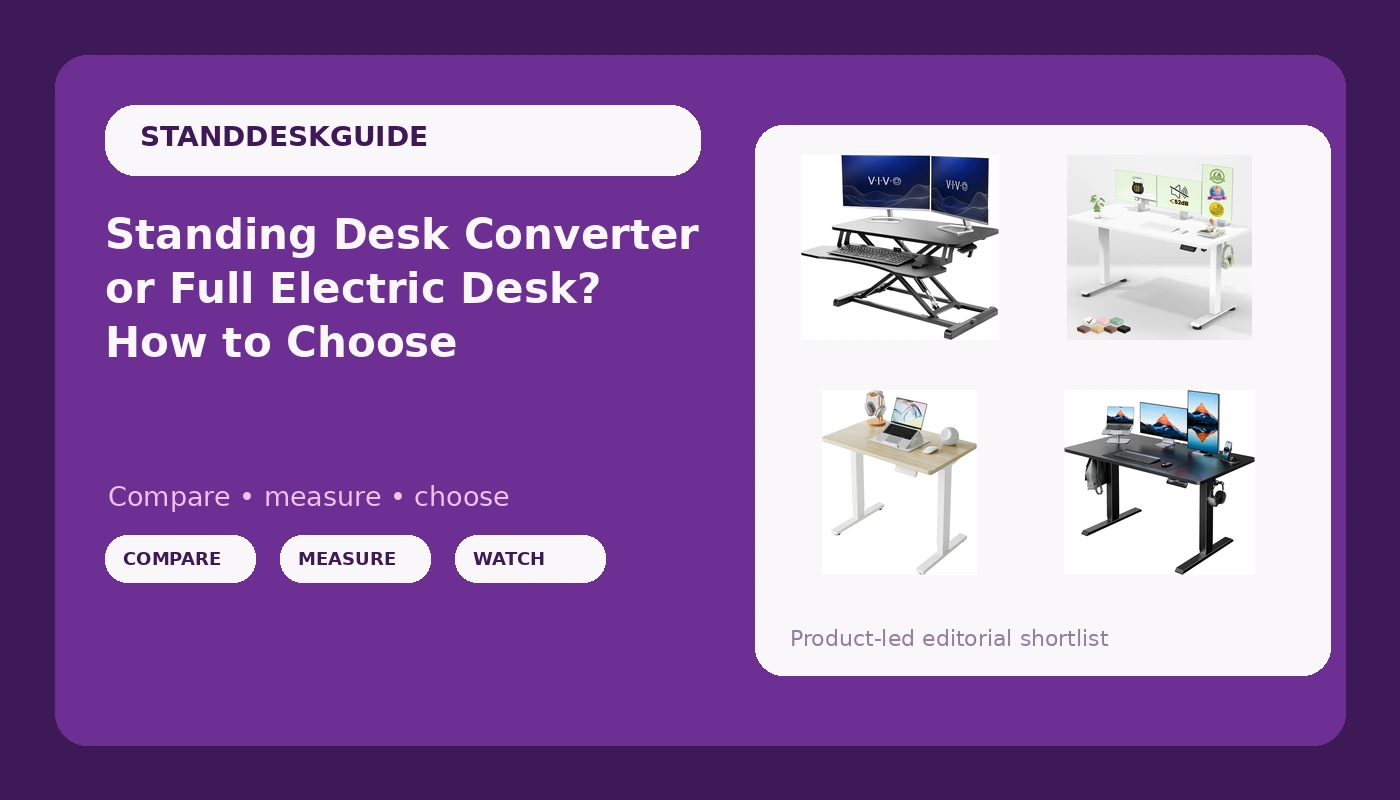
Most people shopping for a height-adjustable desk start with the frame and work backward. That is the wrong order. The first decision is format and footprint: do you keep the desk you already own and put a converter on top of it, or do you replace the desk entirely, and if you replace it, how much floor and wall space are you actually willing to give up? Electric standing desk sizes run from compact 32 by 19 inch tops that tuck into a hallway nook to 55 inch slabs that consume a third of a small bedroom. Get that call wrong and no motor, no controller, and no warranty will rescue the setup. Get it right and almost everything else is a detail you can live with.
Related: Why Standing Desks Wobble at Full Height →
Quick answer
Choose a desk converter if you already own a desk you like and cannot give up the surface area underneath it. Choose a compact electric desk if room is the binding constraint. Choose a mid-size or large electric desk if the desk is the center of your workspace and you want the height range built into the furniture rather than stacked on top of it. Motor count, controller behavior, and cable routing are real decisions, but they are second-order. Settle the footprint first.
4 useful options
| Model | Best fit | What stands out |
|---|---|---|
| Veken 55 Inch Large Electric Standing Desk, Gaming Table, White | Rooms with wall space for a wide top | A 55 inch surface the maker positions for both work and gaming |
| HUANUO 48x23 Inch Electric Standing Desk, Adjustable, Black | A full workstation in a mid-size room | A 48 by 23 inch top, which is the depth most dual-monitor setups want |
| HUANUO 32x19 Inch Small Electric Standing Desk, Adjustable, Light Walnut | Tight corners and narrow rooms | A 32 by 19 inch footprint in a light walnut finish |
| VIVO Black 32 in Standing Desk Converter, DESK-V000K | Keeping a desk you already own | Lifts an existing fixed desk instead of replacing it |
The widest option: Veken 55 Inch Large Electric Standing Desk, Gaming Table, White
Fifty-five inches is not a small commitment. Tape that width onto your wall before you order and stand back from it. If your room has a window, a door swing, or a radiator anywhere along that run, the desk will fight the room rather than fit it. The payoff is a surface where a monitor, a laptop, and a notebook can all sit flat at the same time without a reshuffle every hour. The trade-off is that everything about the desk gets heavier and more awkward to move, which matters if you rent and relocate.
The middle of the road: HUANUO 48x23 Inch Electric Standing Desk, Adjustable, Black
The 23 inch depth is the number worth thinking about, not the 48. Depth governs where your monitor sits relative to your eyes and how much room is left in front of the keyboard. A 23 inch top gives you a genuine two-monitor arrangement without pushing the screens into your face. The 48 inch width means the desk fits along a wall that a 55 inch top would overrun. If you are measuring a specific wall and the answer keeps coming out around four feet, this is the shape you are looking for.
The small-space pick: HUANUO 32x19 Inch Small Electric Standing Desk, Adjustable, Light Walnut
Nineteen inches of depth is the honest constraint. A single monitor and a laptop will fit. A monitor plus a keyboard plus a notebook plus a coffee mug starts to feel like a puzzle. This is the desk for a narrow bedroom, a shared wall, or a spot where the alternative is no desk at all. The light walnut finish also does something practical: in a small room, a lighter top reflects more of the available light and keeps the corner from reading as a black hole.
The no-replacement option: VIVO Black 32 in Standing Desk Converter, DESK-V000K
A converter solves a different problem than an electric desk. It solves the problem of a desk you are not willing to give up: an heirloom table, a built-in counter, a rental that came furnished. The cost is vertical and horizontal space. A converter occupies depth on top of your existing surface, and when it rises it takes the keyboard and monitor with it, so anything you had arranged at the back of the desk has to move. If you have ever tried to work on a desk where the monitor is suddenly six inches too close, you know the feeling.
Prices and availability may change. Product images, names, and retailer links must be matched by verified ASIN. Do not state a current price, rating, stock status, or measured result without current evidence.
Why footprint beats frame specs
Wobble gets all the attention, and it matters. But wobble is a geometry problem before it is a weight problem, and the geometry starts with the desk you picked. A wide top on a narrow base amplifies every lateral input, which is why a 55 inch surface can feel less settled than a 32 inch one even when the frames are comparable. Depth plays the same game in the other direction: a shallow top gives your monitor arm less leverage to work with, and a deep top lets you push the screen back where it belongs.
There is a second reason footprint comes first. Every desk in this group is a single purchase that you will look at every day for years. Motor count and controller behavior are checkable facts you can confirm from a product listing in about ninety seconds. Whether a 48 inch top fits between the closet door and the window is a fact you can only confirm with a tape measure, and no return policy makes that fun.
How to measure before you order
Measure the wall run first, then subtract for anything that opens, slides, or radiates. Then measure the depth you have from the wall to where your chair back sits at its furthest point, because a deep desk in a shallow room means you are sitting in the doorway.
- Measure the available wall run in inches and write it down. Anything within two inches of your measurement is a risk, not a fit.
- Measure the depth from the wall to the nearest obstruction behind your chair. A desk deeper than that number means you lose the walkway.
- Tape the desk footprint on the floor with painter's tape and stand inside it. This takes four minutes and prevents most returns.
- Decide what has to sit on the surface at the same time: monitor, laptop, keyboard, notebook, lamp, mug. Count them.
- Only then compare motors, controllers, and cable routing, because those choices are constrained by the format you just committed to.
Practical guidance
- A converter is the right call when the existing desk is not replaceable, not when it is merely convenient.
- Depth matters more than width for monitor comfort. Nineteen inches is a single-screen desk, twenty-three inches is a two-screen desk.
- If you measure your wall and the answer is ambiguous, go smaller. An undersized desk is usable. An oversized one is a permanent obstacle.
- Check the return window before ordering anything this heavy. Shipping a desk back is a project in itself.
- Confirm the listing details for the exact model before buying: the size in the product name is the size you receive, and similarly named models in the same family are often different footprints.
Which option should you choose?
Choose the VIVO Black 32 in Standing Desk Converter, DESK-V000K when the desk underneath is staying put and you want height adjustment without replacing furniture. Choose the HUANUO 32x19 Inch Small Electric Standing Desk, Adjustable, Light Walnut when the room is the constraint and a single monitor is the realistic setup. Choose the HUANUO 48x23 Inch Electric Standing Desk, Adjustable, Black when you have roughly four feet of wall and want two screens at a comfortable distance. Choose the Veken 55 Inch Large Electric Standing Desk, Gaming Table, White when the wall is long enough and the desk is the center of the room.
These recommendations are based on the formats and stated dimensions in each product listing, not on bench testing of these specific units. Stability, motor noise, controller behavior, and preset retention vary between individual desks and are worth confirming from the listing and current owner feedback before you commit.
The bottom line
The format decision is the one that lasts. A converter preserves a desk you love at the cost of surface depth. A 32 inch electric desk buys you a standing setup in a room that could not otherwise host one. A 48 inch desk is the compromise most people actually need. A 55 inch desk is a workspace, and it asks for a workspace's worth of room. Measure the wall, tape the footprint, count what has to sit on top, and only then start comparing frames.