I spent six years designing office furniture before I ever reviewed a desk for money, which means I learned what a frame costs to build long before I learned what one costs to buy. That gap is the reason this electric standing desk comparison looks the way it does. Two of these four products are desks. One is a converter that turns the desk you already own into a height-adjustable desk. One is a mat. They are not four versions of the same purchase, and treating them that way is how people end up with a riser they raise twice and never touch again.
The rule on my bench has not changed in four years: a desk gets three weeks of daily use at sitting height and standing height, with a real monitor on it, before I say anything useful about it. Wobble gets tested by typing, not by pressing down with a hand. Presets get tested by cutting the power and restoring it. That last test sounds petty until you own a controller that forgets your standing height every time the building flickers.
The short answer: the Furmax 55 inch electric desk is the pick for most people, because 55 inches is the width where a monitor and a laptop actually fit side by side, and full-desk electric travel is the feature you are really paying for. If you are not ready to replace your desk, the FITUEYES converter is the cheapest honest way to find out whether you will stand at all. And if you already stand, the Topo mat is the product that decides whether you keep doing it.
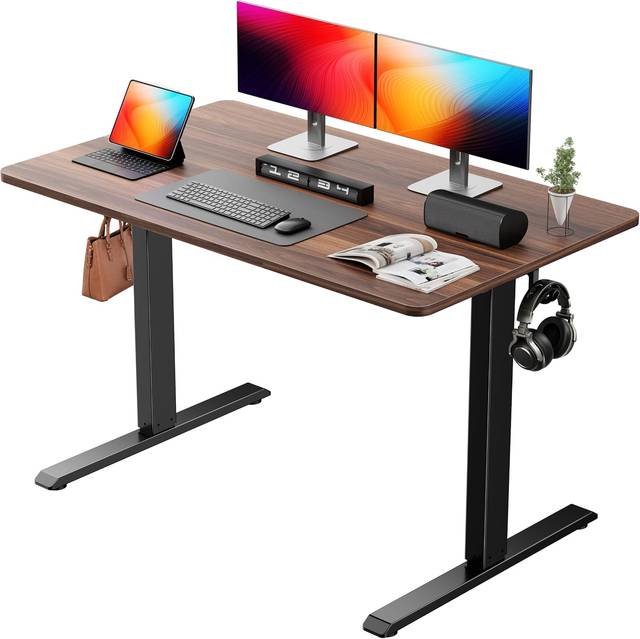
Standing Computer Gaming Office Desk (48 x 24)
Cheapest route to a full electric surface with memory presets; 48 inches fits one monitor plus a laptop
Shallow 24 inch depth and a value frame, so check the crossbar and the wobble at standing height
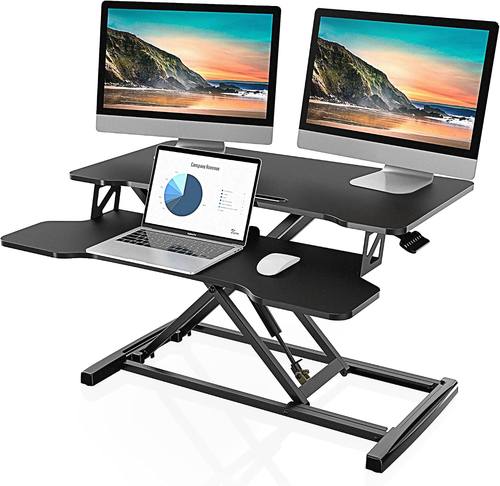
FITUEYES Height Adjustable Sit to Stand Converter (32 inch)
Turns the desk you already own into a standing desk for far less than a new frame
Stacks on your existing desk, so you inherit its stability and lose usable surface

The Standing Desk Mat, Topo by Ergodriven
Calculated terrain that keeps you shifting stance instead of locking your knees
Not a desk, priced like furniture, and useless if you never raise your desk
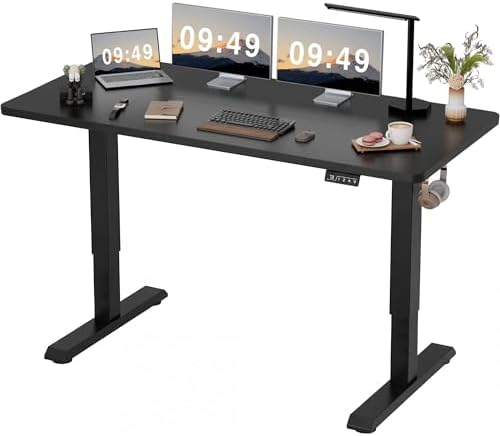
Furmax 55 Inches Electric Height Adjustable Standing Desk
55 inches of width fits a monitor, a laptop, and the rest of the desk clutter
Value frame and controller; test preset retention and wobble at your real standing height
Prices and availability were captured from Amazon Creators API and may change.
Four products, three different jobs
A standing desk purchase is really three separate decisions: how the surface moves, how wide the surface is, and what you stand on. Most buyers collapse all three into "which desk is best," then wonder why they hate the result. The four products here split cleanly. Two of them move the entire work surface, one moves only part of it, and one does not move at all.
That split matters because the failure mode is different for each. A full electric desk fails when the frame wobbles at standing height. A converter fails when you realize you are still looking at the same desk you were bored with, just raised. A mat fails when it is too flat to change how you stand, so you lock your knees and quit after a month.
The 48 inch electric desk: entry point into real height adjustment
The Standing Computer Gaming Office Desk is a 48 by 24 inch electric desk with memory presets and a simple, modern frame. At 48 inches wide you get one monitor and a laptop comfortably, or two monitors if you are willing to run them close together. The presets are the part I would pay attention to here. A desk that returns to your exact standing height with one button gets used. A desk that makes you hold a paddle and eyeball it does not.
The trade-off at this size and class is the frame, always the frame. A 24 inch depth is shallow by standing desk standards, which puts your monitor closer than you might like, and shallow desks amplify front-to-back rock because the load sits nearer the front edge. Before buying, check three things: whether the lifting columns are paired rather than driven by a single motor, whether there is a crossbar or some other brace between the legs, and what the return policy looks like if the wobble at full height is worse than you can live with.
The 32 inch converter: rent the habit before you buy the desk
The FITUEYES Height Adjustable Standing Desk 32 inch Wide Sit to Stand Converter is not a desk. It is a platform that sits on top of the desk you already own and lifts your keyboard, monitor, and laptop together. That distinction is the entire value proposition. If you have a desk you like, or a desk you cannot replace because it belongs to your employer, a converter is the only way to stand without starting over.
The honest case for a converter is that it is a test. The question that kills most standing desk purchases is not "which frame is best," it is "will I actually press the button on a Tuesday afternoon when I am behind on work." A converter answers that question for far less than a full desk. The honest case against it is that you are now stacking one piece of furniture on another. Your stability is your original desk's stability plus whatever the riser adds, your usable surface shrinks, and the keyboard platform has to land at a height that keeps your elbows near 90 degrees, which is not adjustable on every model.
If you work on a laptop and a single monitor, a converter is a genuinely good answer. If you run a wide monitor and speakers, measure your surface first.
The 55 inch electric desk: width is the spec nobody advertises
The Furmax 55 Inches Electric Height Adjustable Standing Desk is the one I would point most people toward, and the reason is width. Fifty-five inches is the first size where a real desktop layout fits without compromises: a monitor on an arm, a laptop beside it, and room left over for the notebook and the coffee that ends up on the desk anyway. Depth matters too, and this class of desk usually gives you more of it than the 48 inch options.
The trade-offs are the usual ones for a value electric desk. The controller is where budget desks cut corners, so presets and their retention after a power cycle are worth checking before you commit. The frame is a value frame, which means the wobble question is real and should be tested at the height you actually work at, not the height in the marketing photos. If you have carpet rather than hardwood, expect more sway than a showroom floor suggests, because a compressible surface under the feet is a stability tax.
What you get in return is a full work surface that moves, at a price that leaves room in the budget for the mat.
The mat: the accessory that decides whether you keep standing
The Standing Desk Mat, Topo by Ergodriven, is the only product here that does not move, and it may be the one that matters most. Standing on a hard floor for two hours is not an ergonomic position, it is a slow punishment, and the reason most people abandon their standing desk by month three is that their feet hurt before their back starts to feel better. A flat anti-fatigue mat helps a little. The Topo is not flat, and that is the point: its raised terrain pushes you to shift your stance and move your feet instead of locking into one position.
The trade-offs are honest ones. It is an accessory priced like a piece of furniture, it is thick enough that you notice the step up when you walk to your desk, and it does nothing for you if you never raise the desk. But if you already own a height-adjustable desk and you are not using it, the mat is very often the missing piece rather than a new frame.
What the spec sheets leave out
Wobble is a geometry problem, not a weight problem. A desk frame is a triangle, and the frame is the hypotenuse. When a manufacturer saves money by removing the crossbar or shortening the leg brackets, the triangle gets weaker and the desk sways side to side at standing height. Adding a heavier monitor does not fix it. Nothing fixes it except a better frame.
Two motors is the minimum, not a luxury. A single-motor desk lifts one column and drags the other through a torque rod or a belt. Under a real load that shows up as a strain sound and, eventually, as a desk that rises unevenly. Two columns, two motors, one controller.
The controller is the part you touch every day. Presets that survive a power cut, buttons that respond on the first press, and collision detection that stops the desk when it meets your monitor instead of grinding through it. Test collision detection on day one, with something you do not care about.
Cable management is overrated, which is why I own a $200 cable tray setup. Do not buy a tray on day one. Run your cables loose for two weeks, figure out where the slack actually needs to live, and then buy the smallest tray that solves the problem you have.
The stability test I would run on any of these
Raise the desk to your real standing height, not the maximum. Put your monitor on it, sit down, and type. Then press the front edge of the desk with two fingers and watch the water in a glass. Then type again. That sequence tells you more than any spec sheet, because it tests the desk under the load and at the height you will actually use.
If the answer is "it moves a little," that is normal. Every desk moves a little. The question is whether the movement happens while you type, because a desk that sways when your hands land on the keys is a desk you will lower and leave lowered.
Which one should you actually buy
If you are replacing a desk and you run more than one screen, buy the Furmax 55 inch and put the mat on your list for month two. If you are replacing a desk on a tighter budget and a single monitor is your whole setup, the 48 inch electric desk with memory presets gets you the same daily habit for less surface. If you are not replacing your desk at all, the FITUEYES converter is the honest experiment, and it will tell you within a week whether the standing habit is real for you. If you already own a desk that moves and you are not using it, buy the Topo mat first and see whether that changes anything.
What I am watching next
The thing I want to see in this price band is preset retention. Controllers are getting cheaper and better, and a desk that remembers your standing height after a power cut is a desk that gets used. I am also watching the 48 inch class specifically, because that is where the budget frames are competing hardest and where the wobble numbers are worst. Three weeks on the bench per unit, as always.