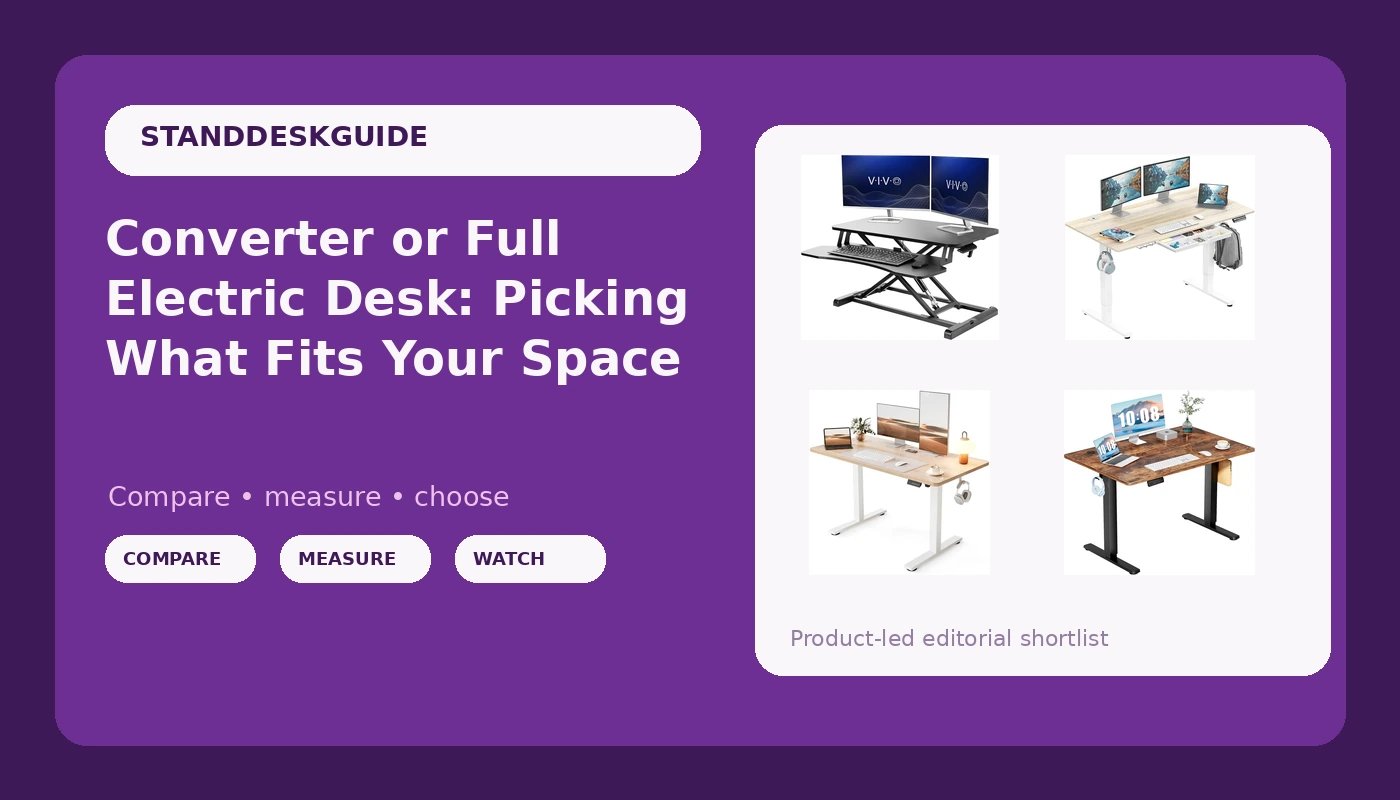
Most people shopping for an electric standing desk are not really choosing between brands. They are choosing between two different objects: a converter that sits on top of the desk they already own, and a complete frame-and-top desk that replaces it. That one decision drives everything downstream, including how much floor space you give up, how much load the lifting mechanism has to carry, and whether the height adjustment still gets used after the first week.
The confusion is understandable. Search results mix both categories into one grid, the thumbnails look similar, and every listing promises the same outcome. But a converter and a full electric desk carry weight differently, adjust differently, and fail in different places. Choosing the wrong category is the expensive mistake. Choosing the wrong frame inside the right category is the daily annoyance.
This explainer covers four currently available options across both categories, then walks through the frame and geometry details that decide whether a desk is still pleasant to work at a year from now.
Related: How Much Desk Wobble Is Normal at Standing Height? →
Quick answer
If you already own a desk you like, and that desk is genuinely stable and deep enough for your monitor, a standing desk converter is the faster path: it adds a lifting platform without a new frame. If you are starting from nothing, or your current desk is a wobbly flat-pack table, buy a complete electric standing desk instead, because the frame is doing the structural work. Once you are inside a category, compare three things: whether the lifting columns are paired rather than single, whether the top is deep enough for your screen distance, and whether the controller stores positions you will actually reuse.
Four useful options
| Model | Best fit | What stands out |
|---|---|---|
| DUMOS 48.6 Inch Electric Standing Desk, Memory Adjustable Home Office Desk | Small rooms and single-monitor setups | A complete electric desk at a 48.6 inch width with memory height adjustment |
| VIVO Black 32 in Standing Desk Converter, DESK-V000K | Anyone keeping the desk they already own | A 32 inch platform that adds height adjustment without a new frame |
| SHW 55 x 28 Electric Height Adjustable Standing Desk w/Drawer, Maple | Wider setups that need storage | A 55 by 28 inch top with an integrated drawer and electric adjustment |
| Cubiker Standing Desk, 48x24 Inches Sit Stand Home Office Desk, Electric Stand up Desk, Adjustable Desk with Splice Board, White Frame/Maple Top | Mid-size rooms and a lighter visual footprint | A 48 by 24 inch electric desk with a splice board top and white frame |
Compact full desk: DUMOS 48.6 Inch Electric Standing Desk, Memory Adjustable Home Office Desk
The trade-off with a compact full desk is surface area. A 48.6 inch top holds one large monitor comfortably, and a second screen only if you are willing to keep the pair narrow or use a stacked mount. The payoff is that you get a real frame with paired lifting columns and a controller, which is the part of a desk that determines whether standing height is usable or wobbly. Memory presets matter more than they sound: a desk that returns to your exact seated and standing positions with one press is a desk you will actually change height on during the day. If your room is tight and you are replacing a desk anyway, this category is the sensible starting point.
Desk converter: VIVO Black 32 in Standing Desk Converter, DESK-V000K
Converters win on setup time and cost, and they lose on independence. A converter raises your keyboard and your monitor together, which means the relationship between your eyes and the screen is fixed by the platform rather than set by you. If your monitor ends up too high at standing height, your options are a shorter platform position or a separate monitor arm. The second consideration is load: a converter adds its own weight plus everything on it to a desk that was engineered as a static surface, so a lightweight or already-shaky desk is a poor host. Check that your existing desk is deep enough that the converter base sits fully on the surface with room for its footprint.
Full-size desk with storage: SHW 55 x 28 Electric Height Adjustable Standing Desk w/Drawer, Maple
The 28 inch depth is the number worth paying attention to, because depth is what buys you viewing distance. A 55 by 28 inch top supports two monitors side by side with room for a keyboard in front, and the extra depth keeps the screens at a comfortable distance instead of a foot from your face. The drawer removes a category of clutter that normally migrates to the desktop. The cost is floor space: 55 inches is a real commitment in a small apartment, and a desk with storage under it has to clear your chair arms and knees through the full range of motion.
Mid-size splice-top desk: Cubiker Standing Desk, 48x24 Inches Sit Stand Home Office Desk, Electric Stand up Desk, Adjustable Desk with Splice Board, White Frame/Maple Top
Splice board means the desktop ships as joined sections rather than one continuous panel, which is how a desk of this size travels in a manageable box. The practical consequences are a visible seam across the top and a joint that needs to sit flush after assembly, so check the alignment during the build rather than after. The 24 inch depth is the other consideration: it is shallower than the 28 inch option above, so a large monitor will sit closer to your eyes unless you mount it on an arm. In exchange, the white frame and maple top read lighter in a room than a black frame, and 48 inches fits through a doorway and into a bedroom-office corner.
Prices and availability may change. Product images, names, and retailer links are matched to verified listings. No current price, rating, stock status, or measured result is stated here without current evidence.
What actually separates a stable frame from a shaky one
Wobble at standing height is mostly a geometry problem, not a weight problem. A desk frame resists side-to-side sway by forming a closed shape with the floor, so a frame with two lifting columns and a horizontal brace under the top spreads the load across a wider base than a single-column design does. When you extend a desk upward, the columns act as levers, and any play at the joints is amplified at the top. That is why two desks with similar-looking tops can feel completely different at 45 inches: the difference is in the columns, the feet, and how tightly the joints are machined.
Motor configuration is the second variable. A paired-column design divides the load and keeps both sides lifting together, which reduces the strain on a single mechanism and helps the top stay level under an uneven load, such as a monitor on one side and a laptop on the other. The controller is the third variable and the one people underestimate. Memory presets, a display you can read, and reliable anti-collision behavior decide whether the desk gets adjusted daily or parked at one height forever. A controller that forgets your positions after a power cut turns a standing desk back into a fixed desk.
Converter or full desk: how the two approaches carry load
A full electric desk puts the load where it belongs. The frame is designed to carry the top plus everything on it through a vertical range, and the feet spread that load across the floor. Your chair, your cable tray, and your monitor arm all attach to a structure intended for it. A converter inverts that arrangement: the platform and everything on it rest on a desk that was engineered for a static surface at one height. That does not make converters unstable, but it does mean the host desk becomes part of the equation, and a hollow-core or flat-pack top is a weak link.
The other difference is independence. A full desk raises your entire work surface, so your keyboard, mouse, and monitor move together while your chair stays put, and you can add a monitor arm to fine-tune screen height separately. A converter raises keyboard and monitor as a single unit, which is simpler but less adjustable. Converters remain the right answer when the desk itself is fine, when you rent and do not want to move furniture, or when you want to test whether you will actually stand before committing to a frame.
- Measure the width and depth of the space, including anything overhead such as shelves or a window sill.
- Measure your seated and standing elbow height, then compare those numbers against the height range the listing states.
- Add up the weight of the monitor, laptop, lamp, and speakers that will live on the surface, and remember a converter adds all of it to your existing desk.
- Decide whether you will press the button daily, which depends on whether the controller stores positions and whether the buttons are where your hand naturally lands.
- Check the wall behind the desk for outlets and cable routing before the first lift, so nothing gets pinched at full height.
Practical guidance before you buy
- Put a level on the floor where the desk will sit. A sloped or springy floor makes any frame feel less stable than it is.
- Leave two to four inches behind the desk for cable bend radius, and route cables with slack at both the seated and standing extremes.
- Set two presets immediately: seated and standing. A third position for reading or a drafting stool is a bonus, not a requirement.
- Test the anti-collision behavior on day one using a soft object, so you learn how the desk reacts before it meets something expensive.
- Re-check every fastener after the first week of height changes, since joints settle once the frame has cycled a few times.
Which option should you choose?
Choose the DUMOS 48.6 Inch Electric Standing Desk, Memory Adjustable Home Office Desk when you are replacing a desk in a small room and want a complete electric frame with saved positions. Choose the VIVO Black 32 in Standing Desk Converter, DESK-V000K when your current desk is solid, deep enough, and worth keeping. Choose the SHW 55 x 28 Electric Height Adjustable Standing Desk w/Drawer, Maple when you want the widest surface here, need viewing distance for two monitors, and want storage built in. Choose the Cubiker Standing Desk, 48x24 Inches Sit Stand Home Office Desk, Electric Stand up Desk, Adjustable Desk with Splice Board, White Frame/Maple Top when a 48 inch footprint fits your room and you prefer a lighter-looking frame and top.
One caveat applies to all four: stability depends on the floor, the load, and how carefully the frame was assembled, not on the category alone. Listings also change, so confirm the current dimensions, height range, and included parts on the product page before ordering.
The bottom line
The converter versus full desk question resolves quickly once you are honest about what you already own. A stable desk you like plus a converter gets you standing for the least disruption. No desk, or a desk you do not trust, points to a complete electric standing desk with paired lifting columns and a controller that remembers your positions. Within that second category, the differences come down to footprint and depth: 48.6 inches for small rooms, 48 by 24 inches for a mid-size setup with a lighter look, and 55 by 28 inches when you want surface area and a drawer. Pick the footprint your room supports, then check the height range against your own measurements before you buy.