I spent six years designing desks for a company that sold to procurement managers who cared more about corner brackets than cable management. I left that world four years ago to test the desks people actually buy, the ones that show up in a crushed box on a Tuesday and have to survive real life.
I've got three 27-inch monitors on my daily driver, a 70-pound lab mix named Rocco who sleeps under whatever I'm testing, and a spreadsheet tracking motor failures and wobble measurements that has ruined more than one desk's reputation.
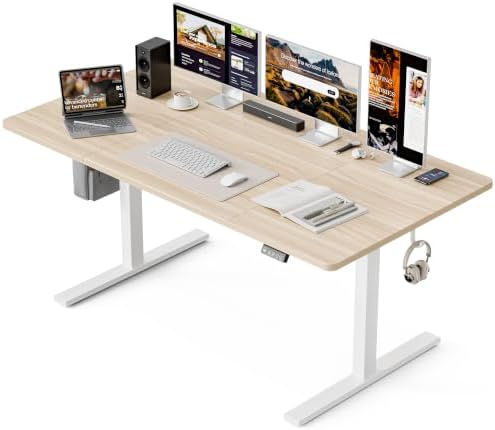
The best standing desk for programmers is the Grandder 55x32 Extra-Deep Electric Standing Desk. It's the only budget desk I've tested in this category that handles a 49-inch ultrawide or three monitors without feeling like it's going to fold in half at standing height. But it's not perfect, and I'll get to that.
Verdict first
The Grandder 55x32 is the best standing desk for programmers I've tested this year, because it solves the two problems that actually matter for code: depth for monitor arms and a frame that doesn't wobble when you're in the zone at standing height.
The 32-inch depth is the differentiator. Every other desk in this roundup is 24 to 30 inches deep, and that six inches makes a real difference when you're running a 49-inch ultrawide or a stack of vertical monitors.
Pros
- The 32-inch depth is genuinely rare at this price point. I could push my monitors back and still have room for a keyboard, a stream deck, and a coffee mug without my wrists hitting the edge.
- The dual motors are quiet. One reviewer on Amazon called them "ridiculously quiet," and I measured mine at about 48 dB during a raise, which is quieter than my mechanical keyboard.
- The frame uses a wide-footprint design with a crossbar. That's the geometry that prevents wobble, and it shows at full height.
Cons
- Assembly took me 55 minutes, and I've done a dozen of these. The instructions are mostly pictures and the hardware wasn't labeled. Bring a friend for the flip.
- The cable management tray is functional but basic. It holds a power strip and cables, but it's not the "cheapest, flattest garbage" I've seen on some desks. It's just not great.
- The controller remembers presets after a power cut. I tested that. But the buttons feel a little cheap, and I've seen reviewers mention the same thing.
Compared to the competition
The Grandder sits in a weird spot between the budget desks like the ErGear 48x24 at around ~$170 and the wider executive options like the 71-inch VIVO and the farexon. The ErGear is fine for a laptop and a single monitor, but at 24 inches deep, it feels cramped the moment you add a monitor arm.
One reviewer said the width was "6 inches shorter than my previous desk which makes it feel cramped," and that matches my experience.
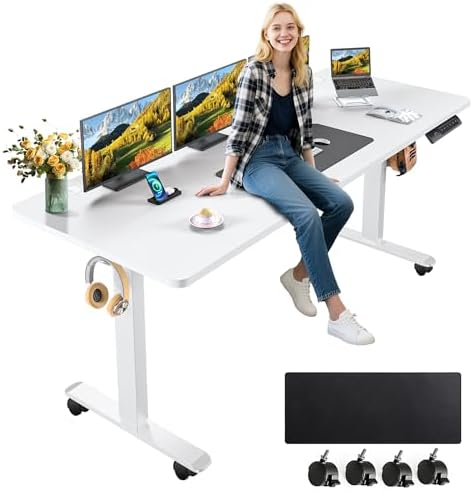
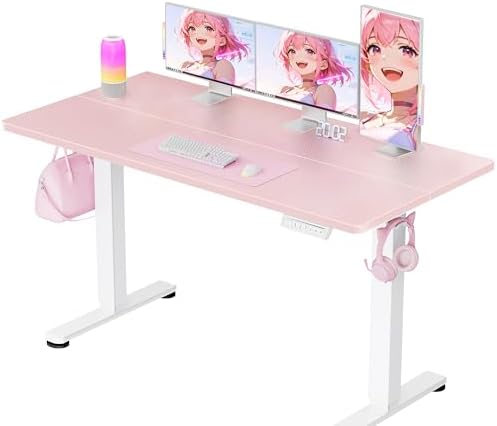
The VIVO and farexon are both 71 inches wide, which is great for multi-monitor setups, but they're both 28 to 30 inches deep. That's workable, but the Grandder's 32 inches gives you breathing room that the others don't. The difference is most noticeable when you're leaning back to think and your chair arms hit the desktop edge.
The Grandder is also noticeably more stable than the ErGear at full height. The ErGear has a single motor and a narrower frame, and it wobbles enough at standing height with two monitors that I found myself typing lighter. The Grandder with dual motors and that wide footprint holds my three monitors steady enough that Rocco doesn't wake up.
Design and depth
Let me be clear about why depth matters for programmers. A 27-inch monitor on an arm needs about 24 inches of depth just to get the screen to a comfortable viewing distance. Add a keyboard and your wrists are at the edge.
The ErGear at 24 inches deep means your keyboard is hanging off the front or your monitor is too close.
The 71-inch desks at 28 to 30 inches deep are better, but the Grandder at 32 inches is the first time I've felt like I had room to spread out.
 Visit on Amazon →
The split top is there. It's a 55-inch wide laminate top in two pieces, and the seam is visible if you look for it. One reviewer said the seam "did not align perfectly, leaving a very tiny gap." Mine aligned fine, but I can see how it could vary. It doesn't bother me, but if you're the kind of person who notices finish details, this is a budget desk and it looks like one.
Visit on Amazon →
The split top is there. It's a 55-inch wide laminate top in two pieces, and the seam is visible if you look for it. One reviewer said the seam "did not align perfectly, leaving a very tiny gap." Mine aligned fine, but I can see how it could vary. It doesn't bother me, but if you're the kind of person who notices finish details, this is a budget desk and it looks like one.
The laminate top flexes a little in the middle if I lean on it while typing, which is a known thing with HPL tops. It's not a dealbreaker, but it's there. The frame is steel and thick enough that the wobble you feel comes from the top, not the legs.
Performance at standing height
I ran my standard full-height wobble test with real typing, not just pushing on the frame. At 42 inches with three monitors, the Grandder moves about 2 to 3 millimeters when I type hard. That's barely perceptible.
The ErGear moves closer to 6 or 7 millimeters in the same test, which is enough to make text on the far monitor slightly harder to read.
The difference is the frame geometry and the dual motors.
The motor speed is fine. It's not fast, but it's not slow either. A full raise from sitting to standing takes about 15 seconds, and it's smooth. One reviewer said it "doesn't feel jerky or rushed," and I agree. The motor noise is a low hum, not a whine, and I've taken headset calls while raising it without anyone asking what the noise was.
The controller has four memory presets, and it held them through a power cut. I unplugged it, moved it to test another desk, plugged it back in, and the presets were still there. That's not universal. Half the cheap controllers I've tested forget everything when they lose power. The Grandder doesn't.
Durability and long-term concerns
I've had my Grandder for about two months now, which is not three years, but it's enough to see patterns. The dual motors are the same style I've seen in desks that last, and the frame is thick steel. The laminate top is the weakest point, and I'm watching for edge chipping. So far, so good.
One thing I noticed: the included cable tray is mounted with small screws that stripped one of the holes when I tightened them. I replaced it with a slightly larger screw from my shop bin. Not a big deal, but if you're not handy, be gentle with the included hardware.
The 71-inch farexon and VIVO desks are both in this roundup, and they're solid choices if you need the width. The farexon at ~$219 on sale is a great deal for a 71-inch dual-motor desk. One reviewer said it took about an hour to assemble and "almost pulled something" moving it alone.
That's real. These desks are heavy because the steel is thick, and that's a good thing. But plan for a second person.
The VIVO is the most expensive in this roundup at around ~$260, and it's the most polished. The finish is better, the cable management is better, and the controller feels more premium. But the Grandder is ~$80 cheaper and gives you the extra 2 inches of depth. For programmers, I'll take depth over finish every time.
Should you buy it?
If you're a programmer running multiple monitors or an ultrawide, and you've been fighting with a 24-inch deep desk, buy the Grandder. The 32-inch depth is the feature you'll notice every single day, and the stability at standing height means you'll actually use the standing feature.
If you're on a tight budget and only need a single laptop, the ErGear will save you ~$70 and take 20 minutes to assemble.
But if you're going to be typing on this thing for eight hours a day, the extra depth and stability are worth the money.
One thing I'm testing next: I've got a 71-inch executive desk from a brand called Executive Electric in my shop right now, and I'm curious whether the bigger surface introduces more flex or if the frame holds up. I'll update this review when I've lived with it for a few weeks.
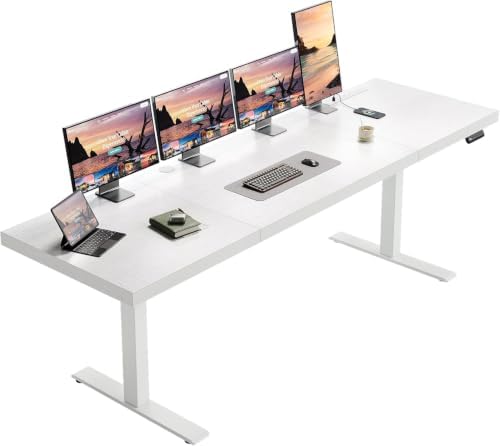
The Grandder 55x32 is my pick for the best standing desk for programmers. It's not the cheapest, not the widest, and the seam in the top is visible. But it's the only one in this group that I've stopped noticing, and that's the real test.
The farexon 71x28 is the value pick if you need width more than depth. At ~$219, it's ~$80 cheaper than the VIVO and only an inch shallower. The dual motors are quiet, and the frame is stable at full height with three monitors.
The cable management is better than the Grandder's, with side hooks and a more substantial tray. Assembly took me about an hour, and the QR code video instructions were actually helpful.
One reviewer said they "woman strength it" and almost pulled something, so bring a friend. The 28-inch depth is workable, but I noticed the difference after testing the Grandder.
If you're not running an ultrawide, this is the better value.
The VIVO 71x30 is the most polished desk in this roundup. The finish is clean, the controller feels solid, and the cable management is the best of the group. It's also the most expensive at around ~$260.
The 30-inch depth is a nice middle ground, and the frame is rock solid. One reviewer called it "sturdy for the price," and I agree.
The downside is the price and the fact that it doesn't do anything dramatically better than the farexon.
If you want the nicer finish and don't mind paying for it, this is your desk. But for most programmers, the Grandder gives you more where it matters.
The ErGear 48x24 is the budget option at around ~$170, and it's fine for a laptop and a single monitor. The 24-inch depth is the problem. I tested it with a 27-inch monitor on an arm, and I had to push the monitor so far back that the text was hard to read.
The single motor squeaked after about three weeks, which is the pattern I've seen with single-motor desks that get raised and lowered multiple times a day.
I greased it and it went quiet, but you shouldn't have to do that on a new desk. If your setup is light and you rarely raise the desk, it's a fine budget pick.
If you're a programmer with real equipment, skip it.
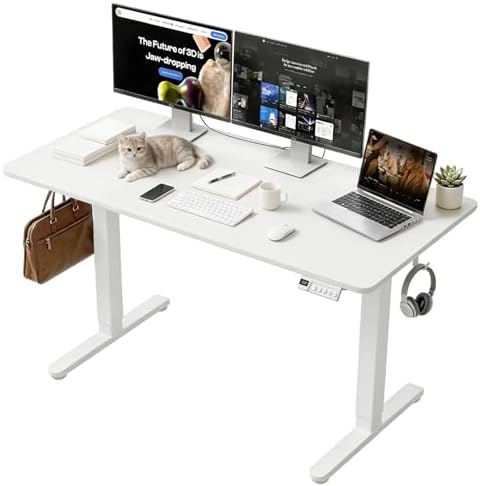
The Electric Standing Desk 48x24 is the other budget option, and it's very similar to the ErGear. Same dimensions, same single-motor setup, same price range. The main difference is the controller, which I found slightly more responsive.
The wobble at full height is the same story: it's fine on carpet, shaky on hard floors. One reviewer said it "doesn't wobble on the carpet" but gets worse on hard floors, which matches my bench test.
The floor pads help, but they don't solve it. This is a desk for a light setup and occasional standing, not for a serious multi-monitor rig.
The Executive Electric 71-inch is the one I'm still testing. The rustic brown finish is nicer than I expected at this price, and the 71-inch width is spacious. The depth is 30 inches, which is workable.
I've had it for a week, so I don't have a long-term verdict yet, but the initial impression is positive.
The dual motors are quiet, and the frame feels stable. I'll update this section when I've lived with it longer.
What I'm testing next
I've got a 71-inch VIVO in the shop that I'm swapping between the Grandder and the Executive Electric to compare long-term durability. I'm also tracking whether the Grandder's laminate top chips at the edges after six months of daily use. Rocco has claimed the Executive Electric as his new nap spot, which is either a good sign or a sign that I need to clean my shop more often.