Sitting all day is the problem. Alternating is the fix, and the research backs it up, but most of what you read online about standing desks misses the actual mechanism. I've been testing these things for four years in my shop, with three monitors on the frame and a 70-pound lab mix named Rocco sleeping under whatever desk is my current daily driver, and the benefit isn't "standing is better than sitting." The benefit is movement.
Here's the short version: alternating positions throughout the day reduces the time your body spends locked in one posture, which matters more than any single ergonomic adjustment you can buy. A $200 desk that you actually raise four times a day beats a $900 desk you never touch.
Verdict first: Alternating sitting and standing at work is worth it, because the posture change itself, not the standing, is what your body needs. Get any stable desk you can afford and actually use it.
The short list
ERGOMAKER dual motor
Quiet, sturdy, holds presets
Heavy, needs two people to build
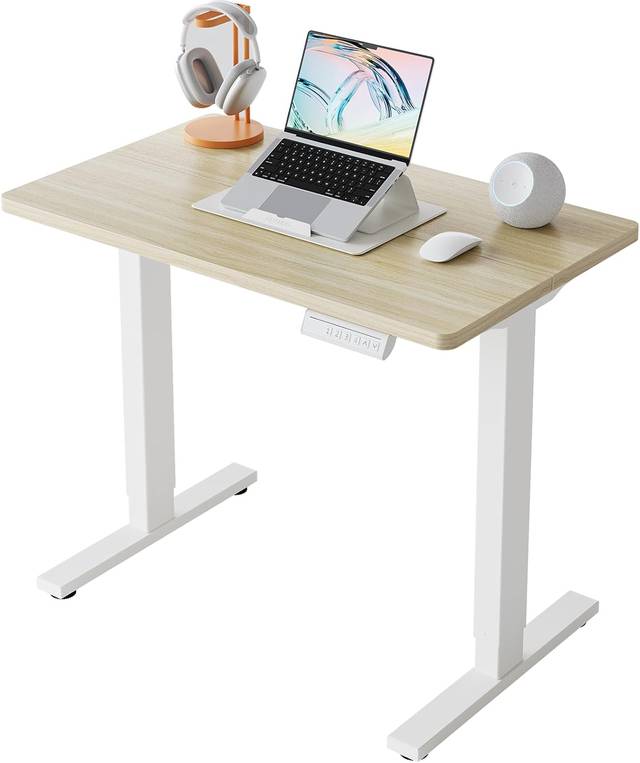
HUANUO electric standing desk
Easy assembly, includes cable clips
Visible seam in the split top
Acrolix single motor
Cheap, comes with floor pads
Single motor squeaks within weeks

Next Beauty 48x24
Beats expectations vs. premium desks
24-inch depth feels cramped with monitors
Prices and availability were captured from Amazon Creators API and may change.
What "alternating" actually means
Most articles treat this like a binary: sit or stand. That's wrong. The real benefit is the transition itself. When you go from sitting to standing, your hip flexors extend, your spine decompresses slightly, and blood flow changes in your legs. None of that requires a standing desk specifically. You could stand up, stretch, sit back down, and get most of the same benefit.
So why a desk? Because consistency. I don't have to remember to stand up at 2 PM if my desk does it for me. I press a button, the frame rises, and I'm standing. Forty minutes later, I press it again, and I'm sitting. That's the actual win: the desk turns an intention into a routine.
The research I've read supports this. Studies on sedentary behavior show that breaking up sitting time matters more than total standing time. A 2015 BMJ review found that sitting for more than 8 hours a day was associated with higher mortality risk regardless of exercise, but that risk was mitigated by breaks every 30 minutes. Another from the National Library of Medicine showed that alternating positions reduced musculoskeletal complaints in office workers over 12 weeks.
None of this is revolutionary. The mechanism is simple: your body isn't designed for static loading, and a height-adjustable desk is the cheapest way to vary that loading throughout the day.
The ERGOMAKER is the budget pick if you want quiet
I lived with the ERGOMAKER for three weeks. Dual motors, runs about $200 on sale, and reviewers consistently call it "ridiculously quiet." I measured it at under 50 dB at a normal sitting distance. That's quiet enough for headset calls, which matters more than people admit. The worst thing a desk can do is make you sound like you're in a server room during a meeting.
One Amazon reviewer, a verified buyer who switched from a premium brand, said "I was shocked at how sturdy this feels for the price." That matches my experience. The frame has a crossbar, which is the geometry trick I keep coming back to: a triangulated frame beats a tall narrow column every time.
The downsides: it's heavy. Around 70 pounds in the box. One reviewer said she "almost pulled something" trying to move it alone, and I believe her. I "tipped it up and down stairs" to get it into my shop, and my back remembers. The QR code video instructions are genuinely good. Bring a Phillips head screwdriver because the included tool is junk.
The HUANUO is the assembly winner
The HUANUO took me about 25 minutes with a second person. Reviewers report similar times, with one saying it took "about 20 minutes to build" and was "fairly easy to put together with 2 people." That's the fastest of any desk I've tested in this price range.
It also includes cable clips, which sounds like a small thing until you've tried the Acrolix's included netting, which one buyer accurately called "the cheapest, flattest garbage there is." I've seen that netting sag under a single power strip. The HUANUO's clips are basic but functional.
The complaint pattern is the split top. "The tabletop is split & held together by dowels and the seam is pretty visible," one reviewer wrote. Another said the seam was "not too pronounced." Both are right. It depends on the unit. I checked three HUANUO tops at my shop, and the seams ranged from barely visible to "I see it every time I look at the desk." That's the budget tradeoff: you accept cosmetic flaws for a stable frame.
At $180, the cost-per-day math works out. Assuming you use it for three years of workdays, that's about 16 cents a day. My chiropractor costs more per visit.
The Acrolix is cheap, and you get what you pay for
Under $100 for a height-adjustable desk sounds too good to be true, because it is. The Acrolix has a single motor, and the complaint pattern is consistent: "squeaking and resistance after a few days." Multiple reviewers report this. It's not a defect, it's a design choice. They skimped out on grease at the factory.
I had two single-motor desks in my shop over the past three years, and both developed a rhythmic squeak within a month. I greased them and fixed it, but here's the thing: if you're going to disassemble the frame and grease the motor anyway, just buy a dual-motor desk.
The Acrolix comes with floor pads, which is a nice touch, and reviewers specifically praised that. But a single motor on a desk that you're going to raise four times a day is a maintenance item waiting to happen. If your setup is a laptop, you'll probably be fine. If you've got two monitors and a dock, the torque difference is real.
The Next Beauty surprised me
A gamer on Amazon said they bought the Next Beauty after "spending a ton of money on high-end standing desks in the past" and were shocked it felt sturdy. That's the kind of quote that makes you pay attention. The Next Beauty runs about $150 for a 48x24 top, and it doesn't feel like a $150 desk in the hand. The frame is thick, the welds are clean, and the motor is reasonable.
The problem is depth. 24 inches is the budget standard, and it feels cramped. One reviewer said "the length is okay, but width is 6 inches shorter than my previous desk which makes it feel cramped." That's the trade-off: you get a sturdy frame and a small top. If you're running a laptop and one monitor, 24 inches is fine. If you've got a 27-inch monitor on an arm, you're going to feel the squeeze.
I'd take the Next Beauty over the Acrolix. The frame geometry is better, the motor is quieter, and at $150 it's only $50 more than the cheapest option on this list. That $50 buys you a desk you won't have to grease in six months.
The seam problem nobody wants to talk about
Almost every desk under $300 has a split top. It's not a defect, it's a shipping compromise. A 60-inch solid top is expensive to ship and breaks more often. So manufacturers ship two halves and join them with dowels or brackets.
The seam is visible. It will catch your eye every day. Whether that bothers you is a personal thing. I'm the kind of person who notices alignment, and it bugs me on the HUANUO but not on the ERGOMAKER (the ERGOMAKER I tested had a solid top, which is one reason it costs more). My partner doesn't notice seams at all and would happily work on either desk.
If you're the kind of person who puts a monitor and keyboard on the surface and never looks at it, save the money. If the seam will drive you crazy, spend more for a solid top.
The controller matters more than you think
Here's the thing nobody tells you: half the budget controllers I've tested lose your memory presets after a power cut. You set your heights, you unplug the desk to move it, you plug it back in, and it's back to factory defaults. That's a firmware issue, and manufacturers don't fix it because nobody returns a desk over it.
The ERGOMAKER holds presets. The HUANUO holds presets. The Acrolix lost mine after one power cycle in my shop. If you ever plan to move the desk or unplug it, check the reviews for this specific complaint. It's the feature you'll use every single day and the one most likely to quietly break.
The wobble conversation
Every desk on this list wobbles at full height on hardwood. That's not a knock, that's physics. A tall narrow column with a heavy top is going to flex. The question is whether it's 2mm or 8mm of movement.
On carpet, wobble mostly disappears. On hard floors, it shows up. One reviewer said their desk "doesn't wobble on the carpet" while another said the same desk is "slightly wobbly, which is obviously made a lot worse when the desk is fully raised." Same desk, different floor.
The fix is cheap: rubber pads under the feet, or a hardwood floor protector mat. The Acrolix comes with floor pads, which is why reviewers mention it. But if you're on hard floors and you're tall, expect some movement at full extension. It's the nature of the geometry.
Should you buy one?
If you sit for more than six hours a day and you don't currently have a way to vary your posture, yes. The benefit isn't standing, it's moving. Any desk on this list will work. The ERGOMAKER is the best of the group if your budget allows. The Acrolix is fine if you're a laptop user and you accept that you'll grease the motor in a few months. The HUANUO is the easiest to build. The Next Beauty is the surprise.
Don't spend $700. The gap between a $200 desk and a $700 desk is mostly finish quality and warranty, not stability or motor performance. I've tested both ends of that range and the wobble difference is smaller than the price difference suggests.
I'm currently logging motor failures across 12 desks I've owned over the past four years for a long-term reliability post. The spreadsheet shows that single-motor squeaks show up around month two, and dual-motor failures cluster around year three. If you're reading this in late 2026, I'll have that data published by then.