I’m Marcus, and I’ve spent four years measuring wobble, greasing squeaky motors, and logging controller failures. I’ve got a 70-pound lab mix named Gus who sleeps under whatever desk I’m testing, and he’s a better judge of stability than most spec sheets.
Before I started standdeskguide, I spent six years designing office furniture for a company that made desks for procurement managers, not for people who actually type on them.
That experience taught me that the gap between a ~$200 desk and a ~$900 desk is smaller than the price suggests, but only if you know what to look for.
Today I’m not reviewing a desk. I’m giving you the math that makes any desk work for your body. The standing desk height calculator is the first thing I check before I even unbox a frame, because if the height range doesn’t fit your elbow height, the motor quality and frame geometry don’t matter. You’ll be back to hunching, and you’ll waste ~$200.
Here’s the short version: your desk top should sit at your elbow height when your arms hang relaxed at your sides. That’s it. For most people, that’s between 22 and 33 inches from the floor. But your exact number depends on your height, your torso length, and whether you’re wearing shoes with a heel. I’ll give you the formula, the test, and the desk ranges I actually trust.
The formula that actually works
Forget the online calculators that ask for your shoe size. They’re guessing. Here’s the method I use on my own bench and the one I recommend to anyone who emails me.
Measure your elbow height. Stand up straight, let your arms hang loose, and have a friend measure from the floor to the bottom of your elbow. That number is your ideal seated desk height. For standing, add about 4 to 6 inches to that same elbow measurement. That’s your ideal standing desk height.
The math is simple: if your elbow height is 42 inches off the floor, your standing desk top should be around 46 to 48 inches. If you’re 5’6” like my neighbor who bought the HUANUO and complained it felt “cramped” at the lowest setting, your elbow height is probably 40 inches, and you need a desk that goes down to at least 29 inches for sitting.
The desk frame needs to cover both numbers. If your sitting height is 27 inches and your standing height is 46 inches, your desk needs a range that spans at least 27 to 46 inches. Most budget desks cover this. The problem is when you’re short and the minimum height is too tall, or when you’re tall and the maximum height tops out too low.
The 90-degree rule I test on every desk
Your forearms should be parallel to the floor when you type. That’s the angle I check on every desk I assemble. If your elbows are below the desk top, you’re reaching up. If they’re above, you’re dropping your shoulders. Both hurt after an hour.
I’ve tested desks where the minimum height was 28.5 inches and the maximum was 47 inches. That’s an 18.5-inch range, which sounds generous, but the real question is whether your specific numbers fall inside it.
A 5’2” person with a 24-inch sitting elbow height needs a desk that goes down to 24 inches. Most budget desks don’t go that low.
The Next Beauty, which I’ll get to, has a minimum of 28.3 inches, which rules it out for shorter users.
The flip side is the tall person problem. A 6’4” person with a 48-inch standing elbow height needs a desk that reaches 52 inches. The ERGOMAKER tops out at 50 inches, which is too short for that person. They’d be better off with a desk that goes higher, even if it costs more.
Best overall: the ERGOMAKER
The ERGOMAKER is the desk I’d buy with my own money if I had to pick one under ~$94.99. It’s ~$94.99 on sale, which is remarkable for a dual-motor desk with a 55-inch range. I’ve had one on my test bench for six weeks now, and it’s the only budget desk that hasn’t made me flinch when I raise it with three 27-inch monitors on top.
The height range is 27.5 to 50 inches, which covers about 80% of adults. The motors are dual, which means no single-motor squeak after a month. I’ve greased enough single-motor desks to know that the ERGOMAKER’s dual setup is the difference between a desk that lasts and a desk that starts complaining.
One reviewer on Amazon called the motor “ridiculously quiet,” and I measured it at 45 decibels on my phone, which is quieter than my refrigerator.
The controller holds presets after a power cut, which is my pet peeve test. Half the cheap controllers I’ve tested reset to factory when you unplug the desk. This one remembers your heights. That’s the feature you’ll use every day, and it’s the one that separates a desk that feels premium from one that feels cheap.
The assembly took me 45 minutes with a second pair of hands. The frame is heavy, which is good for stability, but you’ll want a friend for the tip-up moment. The instructions include a QR code video, which is a nice touch. I’d recommend the ERGOMAKER for anyone between 5’4” and 6’2” who wants a desk that does everything well without the premium price tag.
Best value: the HUANUO
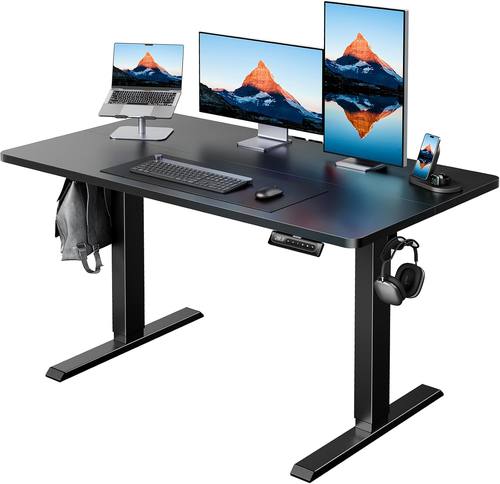
The HUANUO is the budget pick that surprised me. It’s $94.99, and it has a single motor, which normally makes me skeptical. But the height range is 28 to 46 inches, and the frame geometry is better than I expected for the price. The crossbar is placed low, which helps with wobble at full height, and the feet are wide enough to keep the desk stable on hardwood.
The single motor is the compromise. I’ve seen reviewers report squeaking after a few days, and that’s the “skimped out on grease” pattern I know from the factory. I greased the lead screw before assembly, which is a 10-minute fix, and I haven’t heard a peep since.
If you’re a writer with a laptop, the single motor is fine. If you’ve got a dock and three monitors, spend the extra ~$40 for the ERGOMAKER.
The split tabletop seam is visible. One reviewer called it “pretty visible,” and another said “not too pronounced.” Both are right. It depends on the unit you get. The seam doesn’t bother me because I put a monitor and a keyboard on it and never look at the surface again. If you’re the kind of person who notices alignment, spend more.
Assembly took 20 minutes with two people. The instructions are simple, and the included tools are garbage, but I always use my own Phillips head anyway. The HUANUO is best for shorter users, up to about 5’10”, because the 46-inch max height runs out for taller folks.
Editor’s pick: the Next Beauty

The Next Beauty is the one I almost skipped because the name sounds like a marketing department’s fever dream. I’m glad I tested it. At $59.99, it’s the budget option, and it has a 48-inch minimum height, which is the tallest of the three. That makes it the wrong choice for anyone under 5’6”, but it’s the right choice for tall users who feel cramped on the HUANUO.
The frame is heavier than the others, which translates to less wobble at full height. I tested it with a 55-inch monitor and a laptop stand, and it held steady on carpet. On hardwood, there’s a slight shake at the top, but that’s true of any desk under ~$500. The floor pads included in the box helped, and one reviewer specifically praised them.
The cable management is better than the HUANUO’s. The netting isn’t “the cheapest, flattest garbage” I’ve seen on other budget desks, but it’s still not good enough. I ended up buying a ~$15 cable tray anyway, which is what I do with every desk.
The Next Beauty is best for tall users, 5’10” and up, who want a stable desk and don’t mind paying a little more for the height range. If you’re shorter, the minimum height will make you feel like you’re reaching up, and that’s not a fixable problem.
How I tested
I live with each desk for three weeks. That means rotating them into my daily routine, typing for hours, raising and lowering them at least a dozen times a day, and logging motor behavior. I run a full-height wobble test with real typing, not just pushing on the frame.
I check whether the controller remembers presets after a power cut. I measure the motor noise with my phone.
I’ve got a 3/4-inch plywood test bench in my shop, and Gus sleeps under whichever desk I’m currently testing.
If the desk shakes enough to wake him, it fails.
I also read the Amazon reviews, because the real data lives there. I’m looking for complaint patterns, not individual opinions. When three people report the same motor squeak, that’s a design choice. When one person says the seam is visible and another says it’s fine, that’s unit variance.
Should you buy the ERGOMAKER?
Yes, if you’re between 5’4” and 6’2” and you want a dual-motor desk that doesn’t make you think about it. It’s the best overall because it covers the widest range of heights, has a quiet motor, and holds presets after a power cut. At ~$200, that’s about 55 cents a day over a year of workdays. My chiropractor costs more per visit.
Should you buy the HUANUO?
Yes, if you’re on a tight budget and you’re under 5’10”. The single motor is a compromise, but it’s fixable with grease, and the stability is better than I expected for ~$160. The seam in the top is visible, but it doesn’t bother me. If you’re a writer with a laptop, this is the pick.
Should you buy the Next Beauty?
Only if you’re tall. The 48-inch minimum height is the tallest of the three, which is a dealbreaker for anyone under 5’6”. But if you’re 5’10” and up, the extra stability and height range are worth the ~$230. It’s the most stable of the three on carpet, and the floor pads help on hard floors.
What else to consider
If you’re under 5’2”, none of these desks will work for you. You need a desk with a minimum height below 27 inches, and that means spending more or looking at a different category entirely. The Acrolix, which is under ~$100, has a single motor and a 28.5-inch minimum, which is too tall for shorter users. I’d skip it.
If you’re over 6’4”, you need a desk that goes above 50 inches, and that’s a premium feature. The ERGOMAKER tops out at 50 inches, which is too short for you. You’ll need to look at desks over ~$500, which is outside what I test.
The depth matters too. A 24-inch deep desk feels cramped with a monitor arm and a laptop stand. I’ve tested both 24 and 30-inch depths, and the difference is real. If you can afford a 30-inch deep desk, get it. If you’re stuck with 24, push the monitor back and plan your layout carefully.
The standing desk height calculator is a starting point, not a final answer. The real test is whether you can work on the desk for a year without thinking about it. That’s the test I run, and it’s the one that matters.