I have taken apart more standing desks than I have assembled, which is either a hobby or a diagnosis. Nine years around office furniture, six of them on the design side, taught me that the marketing copy and the object under your monitors are usually two different products. This standing desk comparison covers three electric desks at the budget end of the market and one hardwood blank that keeps surfacing in the same search results. All four are judged on the same questions: does the geometry hold at standing height, does the controller behave, and would you still be pressing the button a year from now?
The short answer: the Flexispot EN1 is the most complete desk of the three, because 176 pounds of capacity and four memory presets cover the two things people actually abandon standing desks over. The farexon is the one to pick if the desk has to move. The VIVO wins on pure surface area and deserves a closer look at its spec sheet. The mahogany blank is not a desk, and anyone who tells you otherwise has never tried to clamp a monitor arm to a quarter inch of wood.
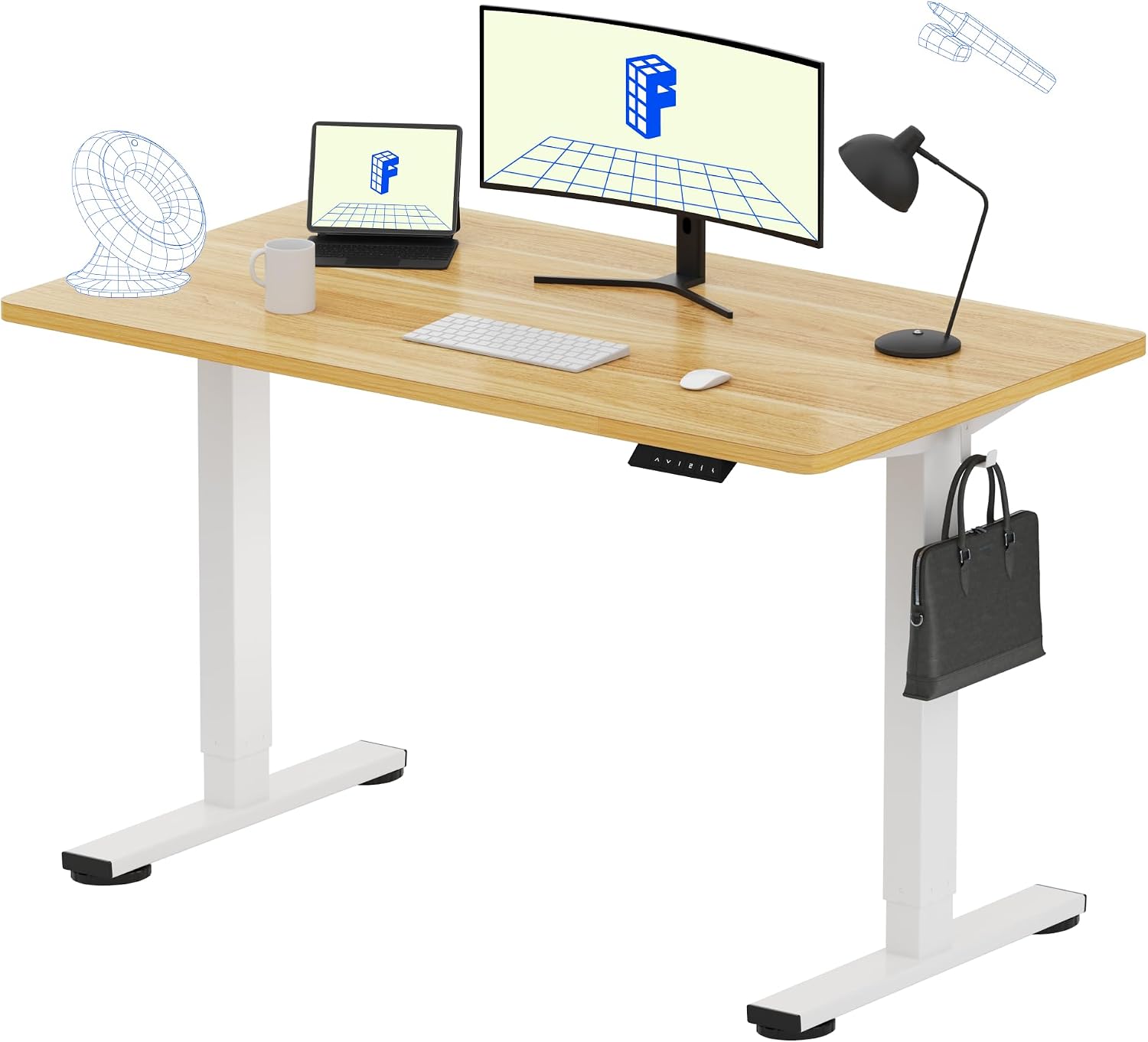
FLEXISPOT EN1 One-Piece Standing Desk, Electric Adjustable with 4 Memory Presets, 176 LBS Capacity, Stable & Quiet, Seamless Desktop for Home Office & Dual Monitors, 48"x24" Maple(White Frame)
The most complete package here: 176 lb capacity, four memory presets, and a one-piece seamless top with no seam to catch crumbs or cable clips
The smallest work surface of the three, and "stable and quiet" is a claim, not a measurement
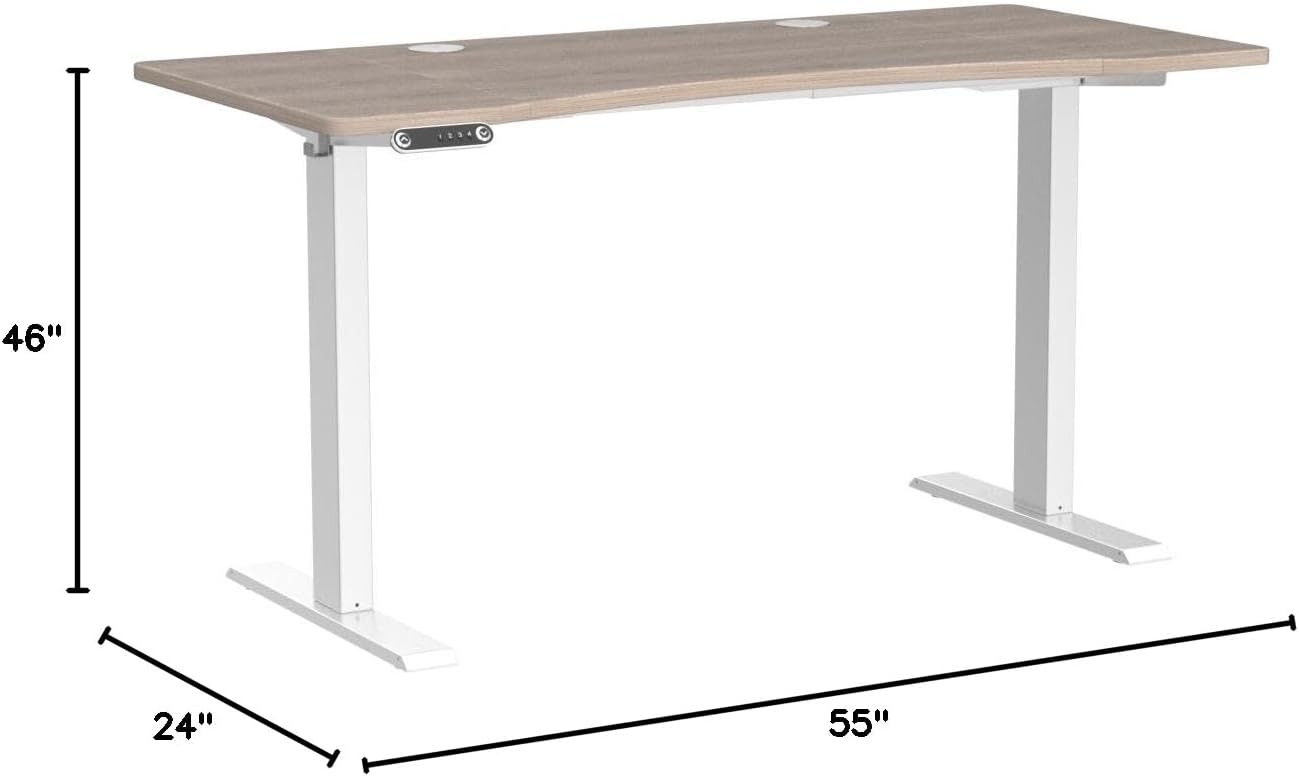
farexon Curved Electric Standing Desk Adjustable Height,55x24 Inches Stand Up Desk with 4 Preset Heights, Lockable Casters,Double Hooks,27.5''-46.5'' Lifting Range Home Office Computer Desk(Oak Grey)
Lockable casters and double hooks, plus a curved front that pulls the keyboard closer without crowding the edges
The 46.5 inch ceiling is low for tall users, and a curved edge makes clamps and monitor arms fussier to place
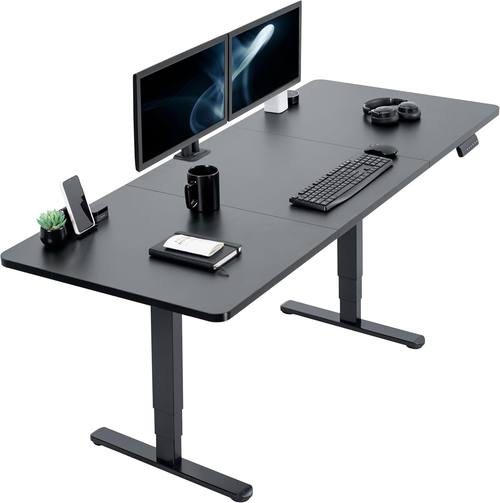
VIVO Black 71 x 30 in Standing Desk, DESK-KIT-2B7B
71 by 30 inches of black surface, the most desk here by a wide margin, and enough width for two monitors and a laptop without stacking
The listing leads with size and says little else, so confirm lift range and motor configuration before you commit

1/4” x 7” x 12” African Mahogany Solid Hardwood Unfinished for Crafts, DYI, Scroll Saw, Woodworking and Laser Engraving (1pc)
Solid, unfinished African mahogany at a price that makes experimentation cheap, whether you cut it by hand or burn it with a laser
A quarter inch by seven by twelve is a blank, not a desktop, and it will never hold a monitor
Prices and availability were captured from Amazon Creators API and may change.
How I judge a standing desk
Wobble is a triangle problem, not a weight problem. The frame is the hypotenuse. A desk with a crossbar resists side to side sway because the brace closes the triangle between the two lifting columns and the floor. A desk without one is relying on the joints at the top of each column, and those joints are the first thing to loosen once a monitor arm starts pulling on the top.
Second, count the motors. Two lifting columns is the minimum I will recommend in 2026. A single motor desk lifts one column and drags the other through a torque tube, and under a real load, meaning a monitor, a laptop, and whatever else accumulates, the dragged column lags and the top twists a few degrees out of level. You feel that twist every time you stand up.
Third, look hard at the controller, because the controller is the part you touch every day and the part manufacturers treat as an afterthought. Four presets sound like a gimmick until you use them, and then they are the difference between a desk that moves and a desk you leave at one height for six months. The test I give any controller: set two presets, cut the power, restore it, and see whether your numbers survived. A controller that forgets is a controller you stop trusting.
Fourth, remember that tops are interchangeable. The frame is the desk. Buy the frame, find the top. That is exactly why the mahogany blank is in this comparison, and exactly why it is not going to win anything.
Flexispot EN1: capacity and presets in one piece
The EN1 arrives as a 48 by 24 inch maple-look top on a white frame, with a 176 pound capacity and four memory presets. The capacity figure is the one to pay attention to. Headroom is what keeps a desk from straining at the top of its travel, and a desk that is nowhere near its limit at standing height is a desk that holds its geometry. The one-piece seamless desktop is a smaller win than it sounds, but a real one: no center seam means no gap for crumbs, no lip for a cable clip to fight, and no place for a laptop to rock.
The presets matter for a different reason. The single most common failure mode for a standing desk is not a dead motor, it is a user who stops changing height because the adjustment is annoying. Four buttons remove the excuse.
The honest caveat is the phrase "stable and quiet." Every desk listing claims it, and the claim is worth exactly as much as the return window. Stability at standing height comes from crossbar geometry and joint quality, not from an adjective. Buy the EN1 for the capacity and the controller, then verify the stability claim in your first week while you can still send it back.
The surface is the trade-off. A 48 inch top holds a monitor and a laptop comfortably. It does not hold a monitor, a laptop, a second screen, and a printer, and if that is your setup, you already know this desk is not the answer.
farexon: casters, curve, and a ceiling on height
The farexon gives you 55 by 24 inches in an oak grey finish, four preset heights, lockable casters, double hooks, and a lifting range of 27.5 to 46.5 inches.
Casters are underrated. Most people buy a standing desk, assemble it in the one place it will live, and then discover they want to vacuum behind it or turn it toward the window in the afternoon. A desk that rolls solves that without a second person and a furniture dolly. Lock them, though. A desk on unlocked casters is a desk that drifts mid-sentence, and the wobble you feel will not be the frame's fault.
The curved front is a genuine design decision, not a styling flourish. It brings the keyboard closer at the center and keeps the far corners within reach, which suits a single-monitor setup and a person who works close to the desk. The cost is clamp real estate. Monitor arms, microphone arms, and light bars all want a straight edge and a flat underside, and a curve gives them less to bite on.
Then there is the ceiling. 46.5 inches is workable for many people, but if you are tall, or if you like to stand with your elbows at ninety degrees and your forearms level, you want more travel than this desk offers. Read that number before you read anything else about the farexon, because it is the one spec you cannot upgrade later.
VIVO DESK-KIT-2B7B: surface area is the whole argument
Seventy-one by thirty inches is 2,130 square inches of black desktop, which is the largest work surface in this comparison by a wide margin. If your setup is two monitors plus a laptop plus a notebook and a coffee, this is the desk that stops you from stacking things on top of other things. Width also buys you separation: two monitors at 71 inches can sit at a comfortable angle instead of pressed edge to edge.
The catch is that the listing leads with size and stays quiet about almost everything else. I will not guess at its lift range or its motor configuration, because those two numbers decide whether the desk suits you, and a guess is not a spec. Read the spec sheet, and treat a missing lift range as an answer in itself. If a listing will not tell you how high the desk goes, it is telling you something.
One engineering note about wide tops: a 71 inch span is a lever. The wider the desktop, the more the ends will move when the frame flexes, so a big top needs a frame that earns it. A desk this wide with an unbraced frame is the classic wobble setup, and the wobble shows up at the ends first, right where your monitor arms are clamped.
The African mahogany blank, honestly explained
The mahogany is a quarter inch thick, seven inches wide, and twelve inches long. It is solid, unfinished African mahogany, sold for crafts, DIY work, scroll saw cutting, woodworking, and laser engraving.
It is in this comparison because people searching for a hardwood desktop keep landing on blanks like this one, and I would rather you know what you are buying. A quarter inch is too thin for a structural desktop, full stop. It will flex under a monitor, it will not take a screw from a leg plate without splitting, and seven by twelve is smaller than a sheet of printer paper. No amount of finishing turns a blank into a desk.
What it is genuinely good for is the small stuff around a desk. A wrist rest cut to length and finished with oil. The feet for a monitor riser. A block for routing cables behind the frame, which is a sentence I write as a man with an embarrassingly expensive cable tray. A backer plate for a headphone hook. A riser under a keyboard. Drawer pulls, a trim strip along the front edge of a top that needs some warmth, or a test piece for the stain you plan to use on a real desktop. African mahogany machines cleanly and takes an oil finish well, so it is forgiving material to learn on.
If you want a hardwood desktop, you buy board feet from a lumber yard, glue up panels, and plane them flat. That is a weekend project and a different article. This is a blank, and it is a good blank.
The trade-offs nobody prints on the box
Capacity versus surface. The desk with the most headroom here has the smallest top, and the desk with the biggest top publishes the least about its frame. Pick which one you will actually notice in month three.
Casters versus rigidity. Rolling desks are convenient and slightly less planted, even locked. If you never move your desk, casters are a feature you pay for and do not use. If you move it weekly, they are the whole reason to buy the farexon.
Presets versus a single button. Two of these desks advertise four memory heights. That is not a spec-sheet tiebreaker, it is a usage pattern. Memory presets are the reason people keep standing.
Curved versus clampable. The farexon's curve is comfortable for typing and inconvenient for accessories. Straight edges are boring and better for arms.
One-piece versus replaceable. The EN1's seamless top is clean and not something you swap. A frame that accepts a separate top is the opposite bet, and the one I usually make.
Price. I do not quote prices in this piece, because they move weekly and a stale number is worse than no number. Follow the link for each desk and use the live figure.
Which one to buy
If you want one desk that handles the whole job with the least fuss, buy the Flexispot EN1. The capacity gives the frame room to work, the presets keep you changing height, and the one-piece top removes a category of small annoyances. Just accept the 48 inch surface for what it is.
If your desk needs to move, or you want a curved front and hooks for a bag and headphones, buy the farexon. Check your standing height against that 46.5 inch ceiling first, and lock the casters once it is parked.
If surface area is the entire point and you will verify the specs yourself, the VIVO DESK-KIT-2B7B is the widest option here. A 71 inch top is a serious amount of desk, and it deserves a frame that can hold it steady at full height.
If you want a small piece of solid hardwood for a riser, a wrist rest, or a cable block, buy the mahogany. It is cheap, it is honest material, and it is not a desktop.
What I am watching next
The budget dual-motor frame market in 2026 is getting dangerous in the best way. Frames that would have cost real money two years ago are showing up with two motors, a crossbar, and a controller that remembers your presets after a power cut. The differentiators are narrowing to three things: whether the anti-collision sensor actually stops the desk before it reaches your monitor, whether the controller survives a power cycle with your numbers intact, and whether the frame is braced well enough to hold a wide top still at standing height.
That is the whole test. Not the marketing, not the finish names, not the number of hooks. Geometry, motors, controller, top. Everything else is decoration.