Related: Best Standing Desks for Small Apartments: Frames That Fit Under 50 Inches
A small standing desk has to solve two problems at once: it has to fit a wall you did not choose, and it has to stay steady at the height you actually work at. Most compact desks solve the first problem and ignore the second, which is why so many of them end up parked at sitting height with the motor never touched again.
I have spent a decade around this category, six years designing office furniture and four more reviewing what other people designed, and I keep five desks in various states of disassembly. The rule I come back to is simple: the frame is the desk, the top is a plank. Measure the wall before you measure anything else.
The four desks below cover four different jobs. One is a full 48-inch electric desk that replaces a real desk. One is the same idea with an extra inch of depth for monitor arms and keyboard trays. One is a converter that turns the table you already own into a standing desk. One rolls, runs on a gas spring instead of a motor, and follows you from the couch to the bed. Picking the wrong category is a more expensive mistake than picking the wrong brand.
Best Overall for a Dedicated Small Office: HUANUO 48x23 Inch Electric Standing Desk
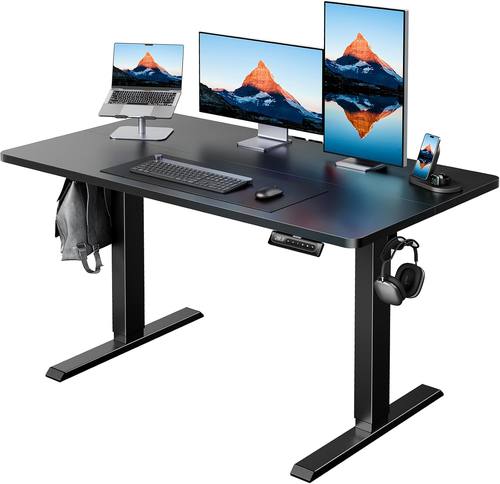
Forty-eight inches wide and twenty-three inches deep is the shape most small home offices should start with. It is narrow enough to sit against a bedroom wall without eating the walking lane, and wide enough for a laptop plus a 27-inch display without stacking one on top of the other. The black finish disappears against a dark wall and stays quiet against a light one.
Electric adjustment matters more than people expect. A desk you fight with is a desk you stop adjusting, and a standing desk that never leaves sitting height is an expensive table. In a small room, the whole case for an electric frame is that the transition costs one button press, which is the difference between standing for twenty minutes after lunch and never standing at all.
Two things to check before you commit. First, the controller: save a preset, unplug the desk, plug it back in, and see whether the height is still there. If the memory vanishes, you will be re-dialing by hand for as long as you own it. Second, run the wobble test the honest way, with your heaviest monitor on the desk and your hands actually typing at standing height. Wobble is a geometry problem, not a weight problem, and no spec sheet will tell you the truth about it.
The twenty-three-inch depth is the real limitation. A large monitor on a deep clamp, a keyboard, and a notebook is a tight fit. If your setup looks like that, read the next section.
The Deeper Version of the Same Idea: ErGear 48 x 24 Inch Electric Standing Desk
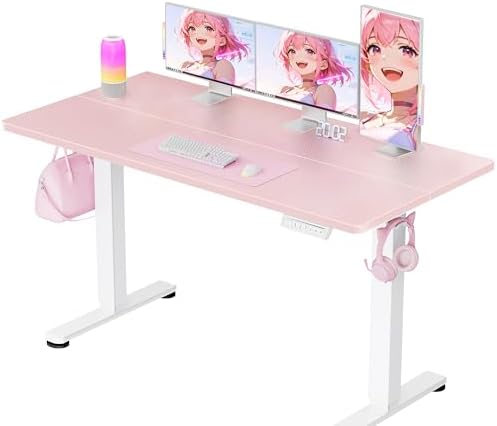
An inch of depth sounds like nothing on a spec sheet. In practice, going from twenty-three to twenty-four inches is the difference between a monitor arm clamp that fits and one that pinches, and between a keyboard with a wrist rest and a keyboard hanging off the front edge.
This is the same category as the HUANUO: a 48-inch electric desk in black, built for one person and one screen. If you know you want a full desk rather than a converter, the choice between these two comes down to which footprint fits your wall and which controller feels right in your hand.
What I would not do is buy either of them for two monitors. Forty-eight inches is a one-screen width in practice. You can squeeze a second display in, but you will be sitting off-center from your main screen, and that is how necks get unhappy.
The extra depth also changes your cable plan. A deeper top leaves room behind the monitor for a tray or a raceway, which is where most of the mess actually lives. Plan that route before the desk arrives, not after.
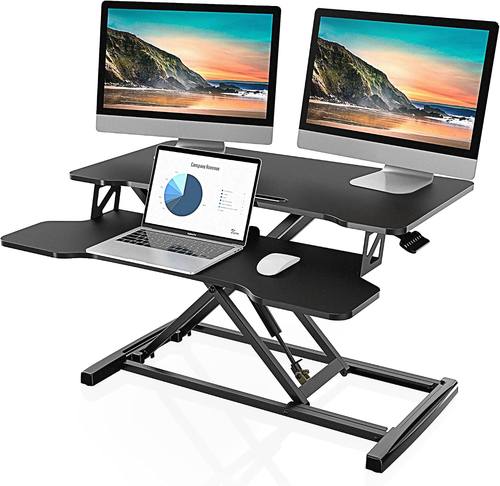
Best if You Already Own a Desk You Love: FITUEYES 32-Inch Sit-to-Stand Converter
A converter is the most misunderstood product in this category. It is not a cheap standing desk. It is a platform that sits on top of the desk you already own and raises your keyboard and monitor together, so the surface you work on goes up while the furniture stays put.
That makes it the right answer in three situations. You rent, and the desk is built in. Your desk is a family piece you are not replacing. Or your room is tight enough that a second frame simply will not fit. At thirty-two inches wide it also works on the narrow writing desks that show up in small apartments, the ones that are a few inches too small for any full-size standing desk.
The trade-offs are real. You give up the top of your desk as working surface, because the converter becomes the working surface. The heights stack, so the platform ends up above a normal desk surface at standing height, which matters if you are short or your monitor sits low. And a converter is only as stable as the desk under it. A wobbly table plus a converter equals a wobbly standing setup, and no crossbar fixes a table with a loose leg.
Check the weight rating against your monitor before you buy, and think about where your hands land once the platform is up. The good versions keep keyboard and screen on the same plane, which is the entire point.
Best for Moving Between Rooms: GTPLAYER Small Standing Desk with Wheels
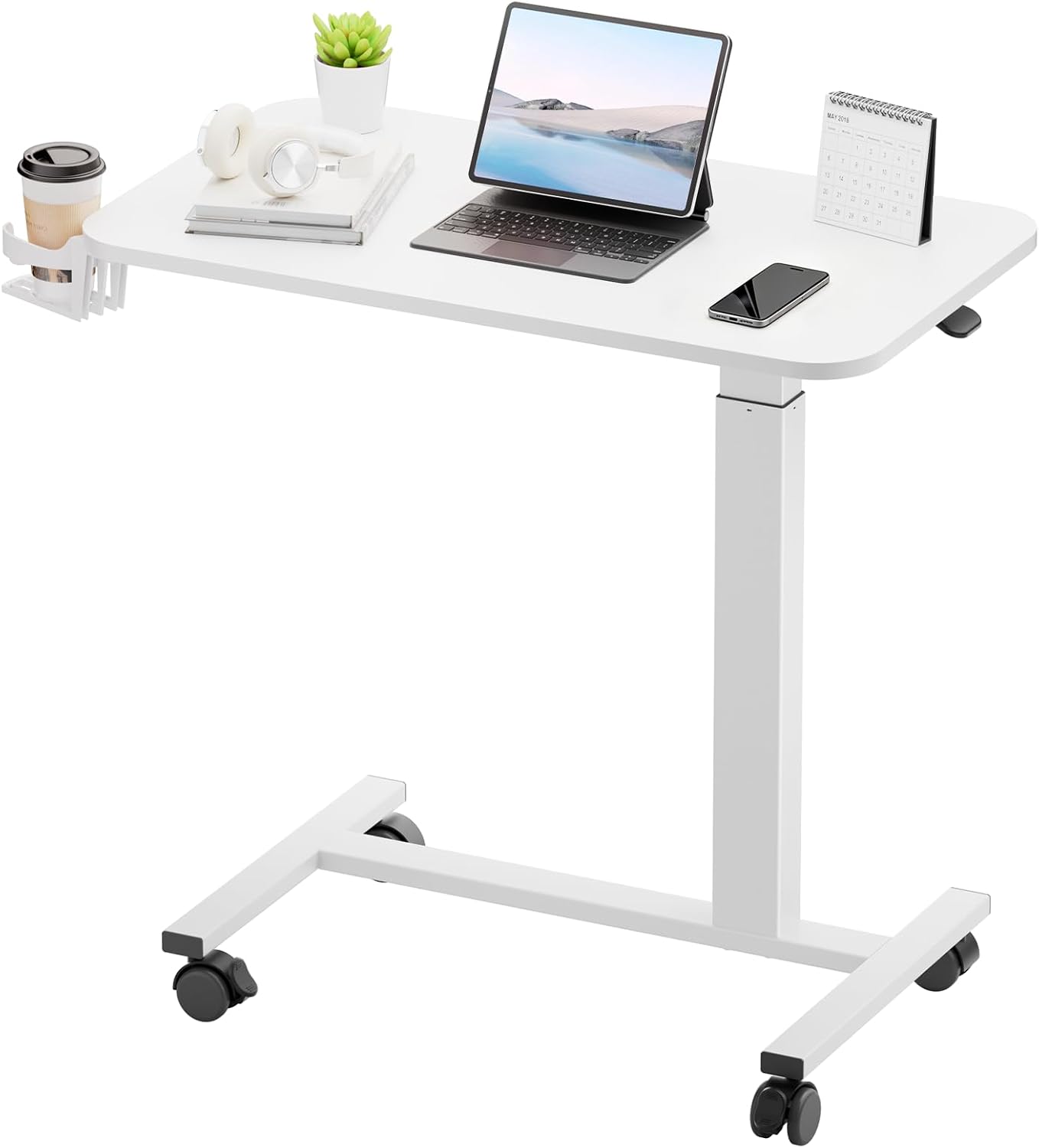
This one is a different animal, and it is what I recommend to people who say they want a standing desk but describe a life that has no home office in it. Twenty-eight inches wide, sixteen inches deep, white, on casters, with a pneumatic column instead of a motor.
Pneumatic means no power cord and no controller. You squeeze a lever, the gas spring does the lifting, and you release it at the height you want. There are no memory presets because there is nothing to remember, and on a rolling laptop table that is fine. The footprint is a laptop footprint, and it is built to roll over a bed or beside a couch, which is why it doubles as a bedside table when you are not working.
The honest limits: sixteen inches of depth holds a laptop and a mouse, not a monitor and a keyboard. There is no crossbar and no second column because there is no motor at all, so judge it as a mobile work surface rather than a desk replacement. If your day is a laptop and video calls, this is a genuinely useful piece of furniture. If your day is two displays and a docking station, keep looking.
The wheels are the feature people underestimate. A desk that moves is a desk that gets used in the room where you actually are, and in a small apartment that flexibility buys more than four extra inches of width.
How I tested
Every desk gets the same three-week rotation, and I would run the same protocol on any of these four before handing over money.
Week one is the wobble test at full height with real typing, not a tap test on an empty top. I load the desk the way a person loads it: monitor, keyboard, the coffee cup that always ends up on the wrong side. If it sways while I type, the desk fails no matter how thick the steel is. Week two is the transition count, where I log how often I actually change height. If the number is low, the problem is the controller or the speed, not my discipline. Week three is the cable audit, because a desk that is a pain to keep tidy becomes a desk with a permanent pile behind it.
I also keep a log of motor failures across every electric desk that comes through here, and the pattern is boring: the desks that die early are the ones that were overloaded or adjusted constantly without a pause. That is a buying problem more often than a brand problem, and it starts with matching the desk to what you actually put on it.
Analysis and test results
Three things separate these four desks, and none of them are on the marketing page.
The first is the difference between a motor and a gas spring. Electric desks give you repeatable heights, presets, and a load rating that can carry a monitor arm or a desktop tower. Pneumatic desks give you speed, silence, and no cord, but they are laptop furniture. Neither is better. They are for different jobs, and buying the wrong one is the most common mistake in this category.
The second is geometry. Stability at standing height comes from the width of the base, the depth of the feet, and whether a crossbar ties the columns together. A desk with a narrow base and no brace will sway no matter how heavy the steel is. When two desks share a width, look at the feet and the bracing before you look at the motor.
The third is the controller, the most underrated part of any electric desk. Memory presets are not a gimmick. They are the difference between a desk you adjust four times a day and a desk you adjust twice a month. A controller that loses its memory when the power blinks will have you back at sitting height within a week.
The small standing desk reference table
| Desk | Adjustment | Footprint | Best for | Price |
|---|---|---|---|---|
 Visit on Amazon → Visit on Amazon →GTPLAYER Small Standing Desk with Wheels |
Pneumatic | 28 x 16 in | Rolling laptop work, overbed and bedside use | $59.20 |
 Visit on Amazon → Visit on Amazon →ErGear 48 x 24 Inch Electric Standing Desk |
Electric | 48 x 24 in | A full desk in a tight room, plus depth for a monitor arm | $99.99 |
 Visit on Amazon → Visit on Amazon →HUANUO 48x23 Inch Electric Standing Desk |
Electric | 48 x 23 in | One screen, one person, a small office wall | $79.99 |
 Visit on Amazon → Visit on Amazon →FITUEYES Sit-to-Stand Converter |
Manual sit-stand converter | 32 in wide | Renters and anyone keeping the desk they own | Check current Amazon price |
The table is the short version. The long version is the same three questions every time: does the footprint fit the wall, does the frame stay steady at the height you use, and will you actually press the button.
Should you buy the HUANUO 48x23 Inch Electric Standing Desk?
Yes, if you want a real desk in a room that will not fit a real desk. Forty-eight by twenty-three inches is about the smallest footprint that still behaves like a full-size desk, and electric adjustment is what keeps the standing feature in your routine instead of in a brochure. Measure the wall first. If a monitor clamp or a keyboard tray needs more depth, move up to the 24-inch version.
Should you buy the ErGear 48 x 24 Inch Electric Standing Desk?
Yes, if an extra inch of depth solves a specific problem: a monitor arm clamp, a keyboard tray, or a raceway behind the screen. It does the same job as the HUANUO with a little more room to work. If you do not have that problem, the smaller footprint is the smarter buy.
Should you buy the FITUEYES Sit-to-Stand Converter?
Yes, if you already own a desk you like and the alternative is replacing furniture you do not want to replace. It is the simplest way to start standing at a desk you already trust. Skip it if that desk wobbles, or if you need more than one screen at standing height.
Should you buy the GTPLAYER Small Standing Desk with Wheels?
Yes, if your work moves. It is a laptop table on casters with a gas spring, and it does that job well. It is not a desk replacement, and sixteen inches of depth will tell you that within the first hour if you try to make it one.