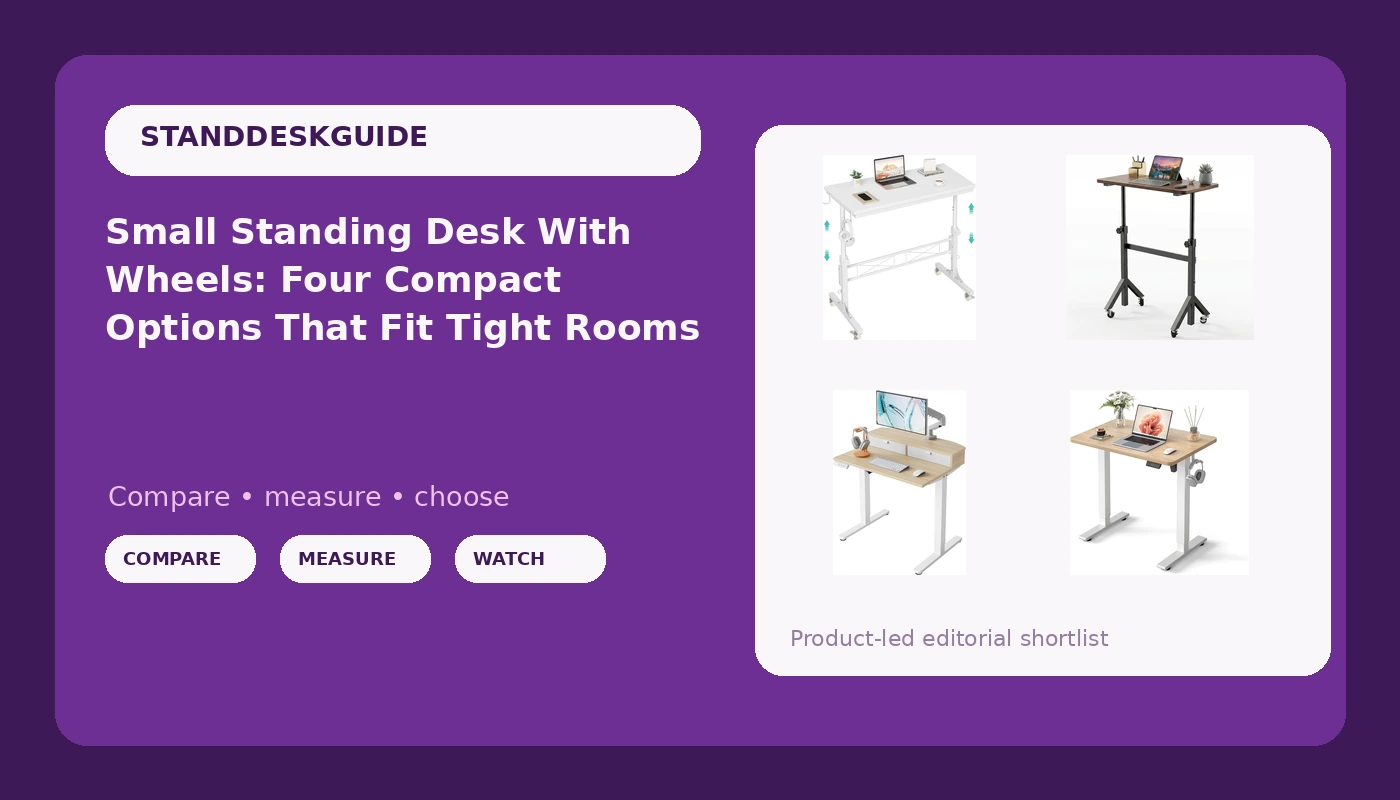
Most people looking for a small standing desk with wheels are not trying to rebuild a full home office. They are trying to fit a genuine work surface into a bedroom corner, a classroom, a rented apartment, or the strip of floor beside a walking pad, and they want that surface to move when the room's purpose changes. That shifts the buying criteria. On a compact desk, width, wheel quality, height range, and how the height actually changes matter far more than lifting capacity, because these desks are asked to hold a laptop, a monitor, and a mug, not a full dual-monitor rig. The four desks below cover what the compact end of the market actually offers: two rolling carts you position by hand, and two electric sit-stand desks with motors, presets, and in one case drawers.
Related: Standing Desk Stability: Why Wobble Is a Geometry Problem →
Quick answer
If the desk has to move, buy a rolling cart with locking casters. Its height adjustment is manual, so you set it and leave it. If the desk has one permanent home and you want to switch between sitting and standing several times a day, buy an electric model with memory presets. The two rolling desks here are the mobile answer; the two electric desks are the repeatable one. Decide which problem you actually have before you compare anything else.
Four useful options
| Model | Best fit | What stands out |
|---|---|---|
| WINAZ Rolling Standing Desk with Wheels, 32" | Classrooms, tutoring, laptop work | Compact white top on wheels with manual height adjustment |
| HUANUO 28-46" Small Standing Desk | Walking pad and laptop setups | Widest adjustable span in this group, on casters |
| HUANUO 32" x 21" Electric Standing Desk with 2 Drawers | A desk with one permanent home | Two drawers, two hooks, four preset heights, C-clamp compatible |
| Cubiker Standing Desk, 32" | Simple electric sit-stand | Electric adjustment, splice board top, white frame and maple finish |
Rolling cart option: WINAZ Rolling Standing Desk with Wheels
The case for a desk like this is simple: it goes where the work is. A teacher moving between rooms, a tutor working at a kitchen table, or someone with a walking pad in a living room does not need a desk that lifts 250 pounds. They need one that is light enough to push and small enough to park against a wall. The trade is the height mechanism. Manual adjustment means you are not changing height mid-task, but it also means there is no motor to strain, no controller to reset, and no preset to lose. If your plan is two hours standing and two hours sitting in the same day, this is the wrong category of desk.
Wider rolling option: HUANUO 28-46" Small Standing Desk
The reason to look at this one instead of the WINAZ is the adjustment span. A 28 to 46 inch range covers seated work for most people and standing work for many, which is unusual on a hand-adjustable cart. The counterargument is the same as with any wheeled desk: casters put the whole frame on a lever, so the taller you go, the more the desk notices a bump in the floor. Lock the casters, keep the load centered, and treat it as a desk that can move rather than a desk you move all day.
Storage-focused electric: HUANUO 32" x 21" Electric Standing Desk with 2 Drawers
Presets are the feature people underestimate. A desk that returns to your exact standing height at one button press gets used. A desk that requires you to hold a button and eyeball the height gets abandoned after a couple of weeks. Four stored heights is more than most people need. The drawers are the more debatable addition, because they occupy some of the space your knees want when you sit. That is a trade rather than a flaw: you gain closed storage and give up a little seated legroom, and the two hooks keep a headset or a bag off the top.
Simple electric sit-stand: Cubiker Standing Desk, 32"
This is the plainest desk in the group, and that is its argument. No drawers taking up legroom, no wheels adding sway, just a lifting column, a 32 inch top, and a controller. The splice board top is worth understanding before you order: it means the surface is assembled from joined sections rather than cut from one continuous panel, which is a normal way to build a compact electric desk without pushing the cost up. It also means you should expect a visible seam and check that the sections sit flush once assembled.
Prices and availability may change. Product images, names, and retailer links must be matched by verified ASIN. Do not state a current price, rating, stock status, or measured result without current evidence.
Rolling cart or electric sit-stand?
The difference between these two categories is not price, it is mechanism. A rolling cart uses a pin, a crank, or a friction collar to hold height. That mechanism is light, cheap, and durable, and it is the reason these desks can be small and mobile in the first place. An electric desk uses one or two lifting columns driven by a motor and governed by a controller. That adds weight, cost, and failure points, and it buys you speed and repeatability.
Repeatability is the part that matters. If you cannot return to the same height reliably, you stop changing height, and a standing desk you never raise is just a small table with a motor bolted underneath. When you compare models, ask what holds the height, how many positions it offers, and whether the controller remembers them after the desk is unplugged. Also check whether the frame includes a crossbar. A crossbar ties the two legs together and resists side-to-side movement, and on a compact desk it is often the difference between a steady surface and a wobbly one at full height.
Sizing a compact desk to a real room
Compact desks fail for boring reasons. They are two inches too wide for the alcove, or the top is too shallow for a clamp, or the casters catch on the edge of a rug. Measure before you compare features.
- Measure the available floor width and depth, then subtract about four inches of clearance for wheels and for your hands reaching past the sides.
- Measure your seated and standing elbow height, and confirm the desk's stated range brackets both.
- Decide how many times a day you will genuinely change height. Under two, manual is fine. More than that, buy presets.
- List everything that has to sit on the top at once, and note whether any of it needs a clamp or a drawer.
- Decide whether the desk moves between rooms. If it does, wheels are the whole point. If it does not, wheels are just a source of sway.
Setup and daily use notes
- Lock every caster before you type. Unlocked wheels are the most common reason a rolling desk feels unsteady.
- Leave slack in every cable before you raise the desk, and route that slack where a wheel will not roll over it.
- Program your standing preset at the height where your elbows sit near 90 degrees, not at the desk's maximum.
- If you pair a walking pad with a rolling desk, check that the pad does not touch a caster leg when both are in position.
- Recheck the frame bolts after the first week. Compact desks ship folded, and assembly settles.
Which option should you choose?
Choose the WINAZ Rolling Standing Desk with Wheels, 32" when you need the smallest, simplest moving surface for a classroom, a tutoring setup, or laptop work. Choose the HUANUO 28-46" Small Standing Desk when you want that same mobility with a much wider height span for a walking pad or a standing laptop setup. Choose the HUANUO 32" x 21" Electric Standing Desk with 2 Drawers when the desk has one home and you want presets, closed storage, and clamp compatibility. Choose the Cubiker Standing Desk, 32" when you want electric height adjustment and nothing else on the frame.
None of these is a substitute for a full-size dual-motor frame if you plan to load a large monitor, a desktop tower, and a printer onto the same top. Compact desks are compact for a reason, and the specifications that decide whether you keep using one, the height range, the number of presets, and whether the frame includes a crossbar, are the ones worth confirming on the listing before you buy.
The bottom line
Two of these desks roll and two of them lift themselves, and that split matters more than any other difference between them. Buy a rolling desk if the room, not the desk, is the constraint. Buy an electric desk if the height change itself is the point, and pay attention to presets, because that is the feature that decides whether the standing half of a sit-stand desk ever gets used.