I have taken apart more desk frames than most people will ever sit at. Ten years of it: six designing office furniture, four reviewing it. My garage currently holds five desks in various stages of disassembly, and my logbook tracks which motors die and when. So when I line up four products for a standing desk comparison, I am not looking for the one with the prettiest marketing photo. I am looking for the one that will still be stable in year three, at the exact height you actually work at.
That is the awkward part of this category. Almost every desk looks fine in a listing photo. Almost every desk feels fine in week one. The differences show up later, in the side to side sway at standing height, in a controller that forgets your presets after a power cut, in a frame that sags once you clamp a monitor arm to it and load the arm with a 27 inch panel.
This comparison covers three desks and one item that has no business on a desk list at all. I will deal with that one honestly, because it is in the lineup and pretending otherwise wastes your time.
Short answer: the OffiGo 71 inch reversible L shaped desk is the most work surface you can put in a single room, the ONBRILL 47 inch solid wood desk is the one that reads as furniture rather than equipment, and the WINAZ 40 inch rolling desk is the only one here that can follow you from the office to the couch. Those are three different problems, which is why this is a comparison and not a ranking.
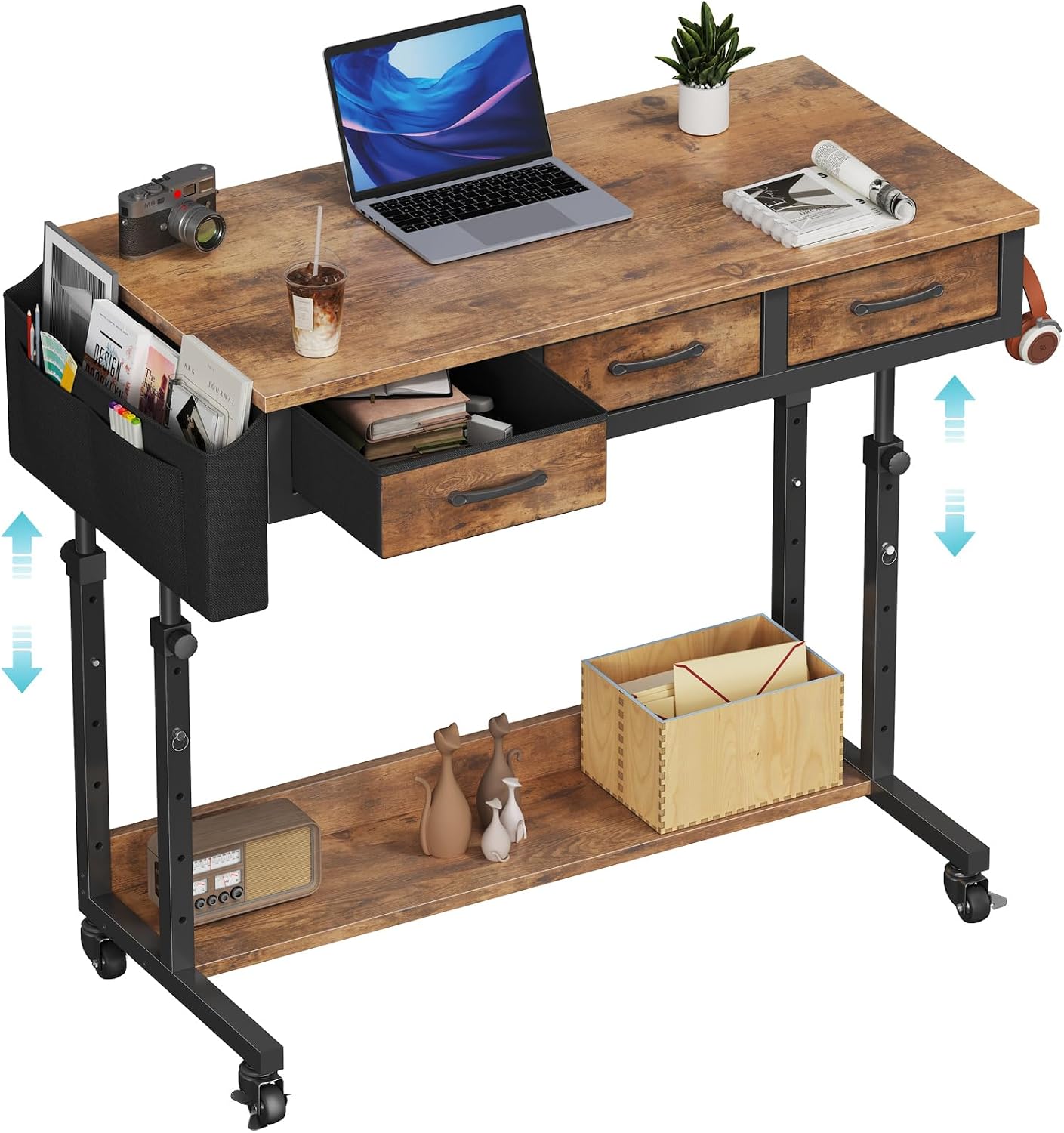
WINAZ Rolling Standing Desk, 40 Inch with Drawers
The only mobile desk in the group, storage built in, rolls between rooms on its own casters
A 40 inch top on a rolling base is the least stable geometry here; check the lift mechanism carefully
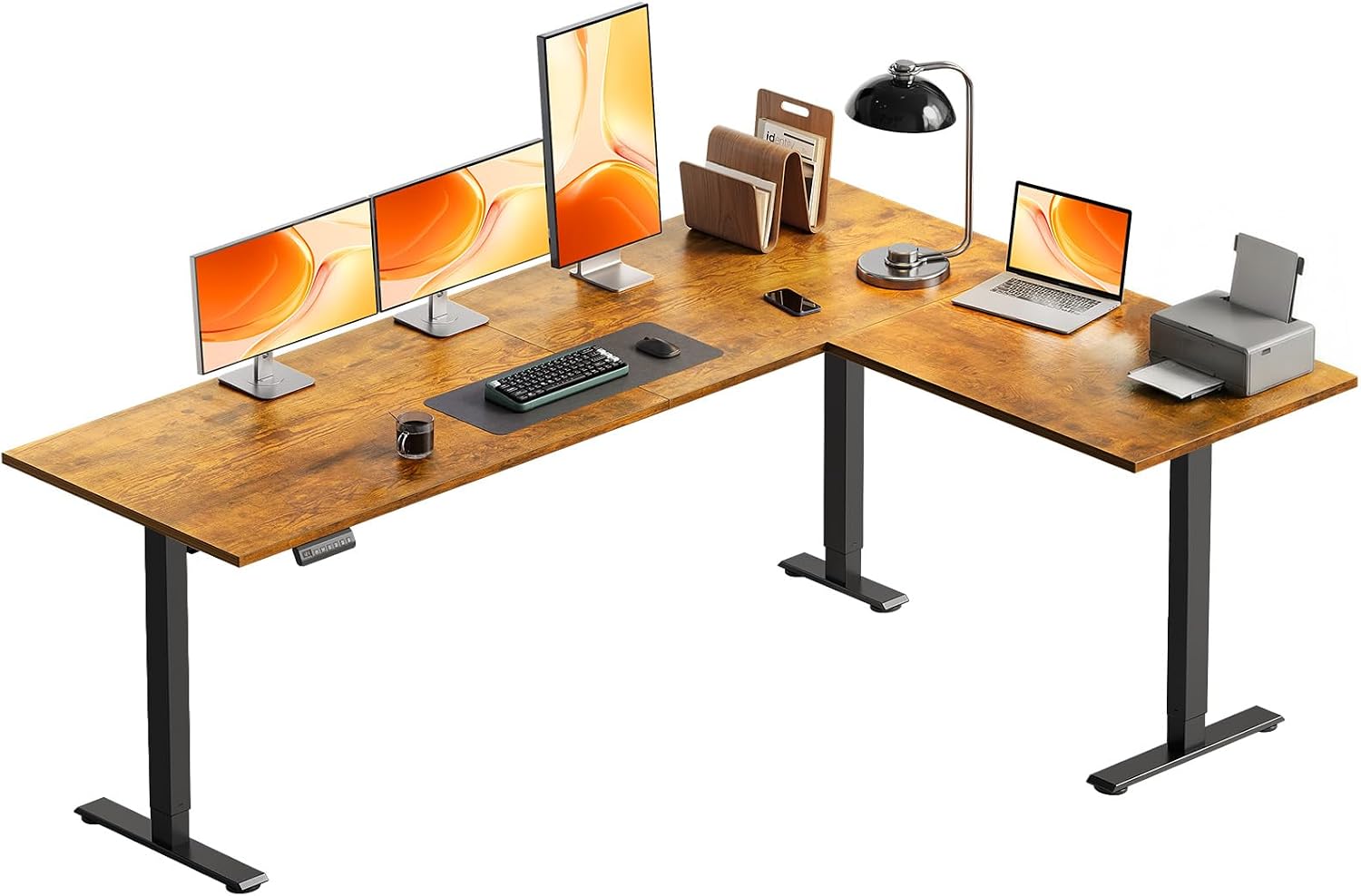
OffiGo 71 Inch Reversible L Shaped Electric Standing Desk
Enormous corner footprint, reversible return, electric height adjustment
Needs a dedicated corner, and an L frame has more joints that can sway
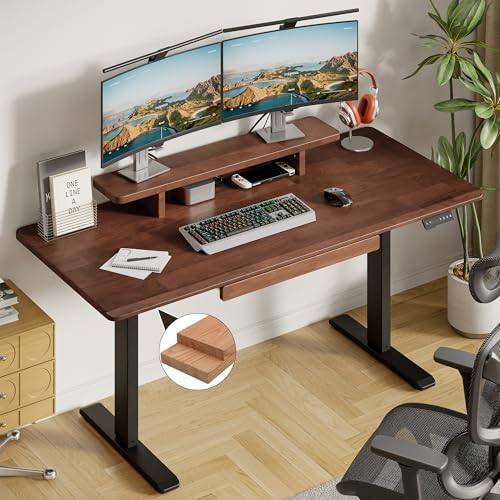
ONBRILL Standing Desk with Drawer, 47x23.6 Solid Wood
Solid wood top, integrated drawer, the cleanest silhouette of the three
47 inches is one monitor plus a laptop, and the drawer eats under top clearance

TTRCB 2 Pack Car Drying Towels, 48 x 24 Inch
As a desk and monitor wipe it is genuinely overqualified
It is a car drying towel. It is not a desk
Prices and availability were captured from Amazon Creators API and may change.
How I judge a desk before I trust it
Before we get into the four products, here is the filter I run everything through, because it explains every verdict below.
Wobble is a geometry problem, not a weight problem. People assume a heavy desk is a stable desk. Not true. A desk sways because the frame has no triangle in it. Two vertical lifting columns with nothing joining them at the bottom, a shallow foot depth, and a thin top make a parallelogram, and a parallelogram moves. A crossbar between the columns turns that parallelogram into two triangles, and triangles do not move. When you look at a listing, look for a crossbar, look at how far the feet extend front to back, and look at the top thickness. Those three specs predict stability better than any weight rating.
Dual motors are the floor, not a feature. A single motor driving two columns through a shaft is the cheapest way to build an adjustable desk, and it is the way that strains, sags, and drifts out of level under a real load. If a listing does not clearly state two motors, assume one until proven otherwise.
The controller matters more than the frame. This is the part nobody photographs. A desk you fight with is a desk you stop raising. Presets are not a gimmick, they are the difference between actually using the standing height and leaving the desk at 29 inches forever. Collision detection is the difference between a stopped desk and a cracked monitor. Test both on day one, and test the presets again after you unplug the desk, because a controller that loses its memory on a power cycle is a controller you will resent for years.
One honest disclosure before the individual sections. I have not run these four specific units through my usual three week daily rotation at both sitting and standing heights, so treat what follows as a design and specification comparison backed by years of frame work, not a lab report with my own wobble numbers. Where a number matters and the listing does not give it, I say so.
WINAZ 40 inch rolling desk: the one that moves
The WINAZ is a 40 inch height adjustable desk with drawers, on wheels, in rustic brown, aimed at bedrooms, home offices, and the space beside a couch. It is the smallest and the most mobile thing in this comparison, and those two facts are the whole story.
What it solves is real. Most people do not have a dedicated office. They have a corner of a bedroom that has to become something else in the evening. A desk with locking casters and built in drawers can live against the wall during the workday and roll out of the way afterward, and the drawers mean your notebook, pens, and charger travel with the desk instead of living in a pile on top of it. For a laptop only setup, that is a genuinely tidy solution, and no other desk here does it.
What it costs you is stability headroom. A 40 inch top on a rolling base is the hardest geometry in this group to keep quiet at standing height. Casters put the whole frame on four small contact patches, a narrow top limits how wide the base can be, and if you type with any force at all, you should expect some movement at full extension. That is not a defect, it is physics, and anyone who tells you a rolling desk is as planted as a fixed frame is selling something.
One thing to verify on the listing rather than assume: the lift mechanism. Height adjustable can mean an electric motor, or it can mean a manual lift. Check which one you are buying, and check the maximum height against your own standing elbow height, because a 40 inch class desk is often aimed at laptop and occasional standing use rather than a full eight hour standing day.
Buy it if your space has to do two jobs. Skip it if you want to stand for hours and type hard. Visit on Amazon →
OffiGo 71 inch reversible L shaped desk: the corner command center
The OffiGo is a 71 inch reversible L shaped electric standing desk in rustic brown, and it is the largest surface in this comparison by a wide margin. Reversible means the return can be mounted on the left or the right, which matters more than people expect. If your room only offers one usable corner, a fixed orientation L desk either fits or it does not. A reversible one fits either corner, and that flexibility is worth paying attention to.
Seventy one inches of L shaped surface changes how you work. A monitor plus a laptop plus a keyboard plus a notepad plus a coffee stops being a stacking problem. You get a primary run for the screen and a return for everything else, which is why L shaped desks are the default for anyone running two displays or a display plus a drafting setup.
The trade-offs are equally clear. An L shaped frame has more joints than a straight frame, and every joint is a place where sway can start. The return arm in particular acts like a lever, so the corner where the two runs meet is doing the hardest structural work in the whole desk. When you look at the listing, look for how that corner is braced and whether the frame runs a crossbar, because that is the difference between a corner desk and a corner desk that hums while you type.
Second trade-off: footprint. A 71 inch L is a commitment. Measure your corner twice, including how far the return projects into the room, because this is not a desk you reposition on a whim.
Third: assembly. More surface, more frame, more fasteners. Budget an evening, and do it on a soft floor with the hardware sorted, not on carpet in the dark.
Buy it if you have a dedicated corner and two screens. Skip it if your room is a hallway with a window. Visit on Amazon →
ONBRILL 47 inch solid wood desk: the furniture answer
The ONBRILL is a 47 by 23.6 inch standing desk with a drawer and a solid wood top. Of the three desks here, this is the one that looks like furniture instead of a mechanism, and the solid wood top is the reason.
Top material matters more than the frame marketing suggests. A solid wood top holds a monitor arm clamp without crushing, holds screw threads for years without stripping, and can be sanded and refinished if you scratch it. Particleboard with a veneer cannot do any of those things. A heavier solid top also adds inertia, which helps a frame feel settled, provided the frame is rated to carry it.
The drawer is the detail I would weigh carefully. An integrated drawer keeps the surface clear, which is the whole point, but it also occupies the space directly under the front edge of the top. If you use a keyboard tray, or you want a lot of knee clearance, check the drawer depth and the under top height before you commit.
Forty seven inches by 23.6 is a middle footprint. That is one monitor plus a laptop comfortably, or one ultrawide, or a laptop with a separate keyboard and mouse. It is not an L desk and it will not pretend to be.
One thing to confirm on the listing: the height mechanism and its range. The product is described as a standing desk, and it is worth verifying whether that means an electric lift, what the low and high limits are, and whether the frame includes a crossbar, because a solid wood top on a frame without one is a heavy parallelogram, and heavy parallelograms still move.
Buy it if you want a desk that ages well and looks like it belongs in a house. Skip it if you need to spread out. Visit on Amazon →
The item that does not belong here
The fourth product is the TTRCB 2 pack of car drying towels, 48 by 24 inches, 1400 GSM, double twisted loop microfiber, and I am not going to pretend it is a desk. It is a car drying towel. Two of them. It is extra large, ultra absorbent, and marketed for SUVs, RVs, and trucks.
Here is the only honest reason it earns a mention on a desk site. A 1400 GSM twisted loop microfiber is what you want for wiping down a desk top, a monitor bezel, a laptop lid, and a keyboard deck without streaks and without leaving lint behind. It is overqualified for that job. One towel outlasts a stack of thin electronics cloths, and at 48 by 24 inches it is actually wider than the 23.6 inch depth of the ONBRILL top, so it covers a full desk in one pass.
That is a real, if narrow, use case. It is still not a desk, it will not hold a monitor, and if you came here to buy a desk you should scroll back up. Visit on Amazon →
The trade-offs, side by side
Buy the WINAZ 40 inch rolling desk if your workspace has to disappear at the end of the day, you work from a laptop, and you would rather have storage and mobility than a rock solid standing platform.
Buy the OffiGo 71 inch reversible L shaped desk if you have a dedicated corner, you run two screens or a screen plus reference material, and you want electric height adjustment across the widest surface here.
Buy the ONBRILL 47 inch solid wood desk if you want a desk that reads as furniture, you care about the top material holding up to a monitor arm and a few years of use, and you are working at a middle footprint.
Buy the TTRCB towels if you want to keep whichever desk you pick free of dust and fingerprints. That is the entire pitch, and it is a fair one.
What to check on the listing before you click buy
Four things, in this order.
First, motor count. If the listing says electric but never says dual motor, assume a single motor and price that assumption into your decision. Two columns, two motors, no shared shaft, that is the standard I would hold any 2026 desk to.
Second, the crossbar. Look at the photos of the underside. A horizontal brace connecting the two columns is the single cheapest structural upgrade a manufacturer can make and the one they most often skip. No crossbar, expect sway at standing height.
Third, height range against your own body, not against an average. Measure your seated elbow height and your standing elbow height, add an inch, and compare those two numbers to the stated low and high limits. A desk that tops out below your standing elbow height is a seated desk with extra steps.
Fourth, the controller. Presets, collision detection, and memory retention after a power cut. Those three features determine whether you actually use the height adjustment or leave the desk parked. Ask about them, or check the manual, before you buy.
I keep five desks in my garage because I keep finding the same failure at the same place: a frame that was fine in the showroom and tired by month eight. Pick the desk that fits the room you actually have, not the room in the photos, and verify the frame details before you commit. That is the whole method, and it has not failed me yet.