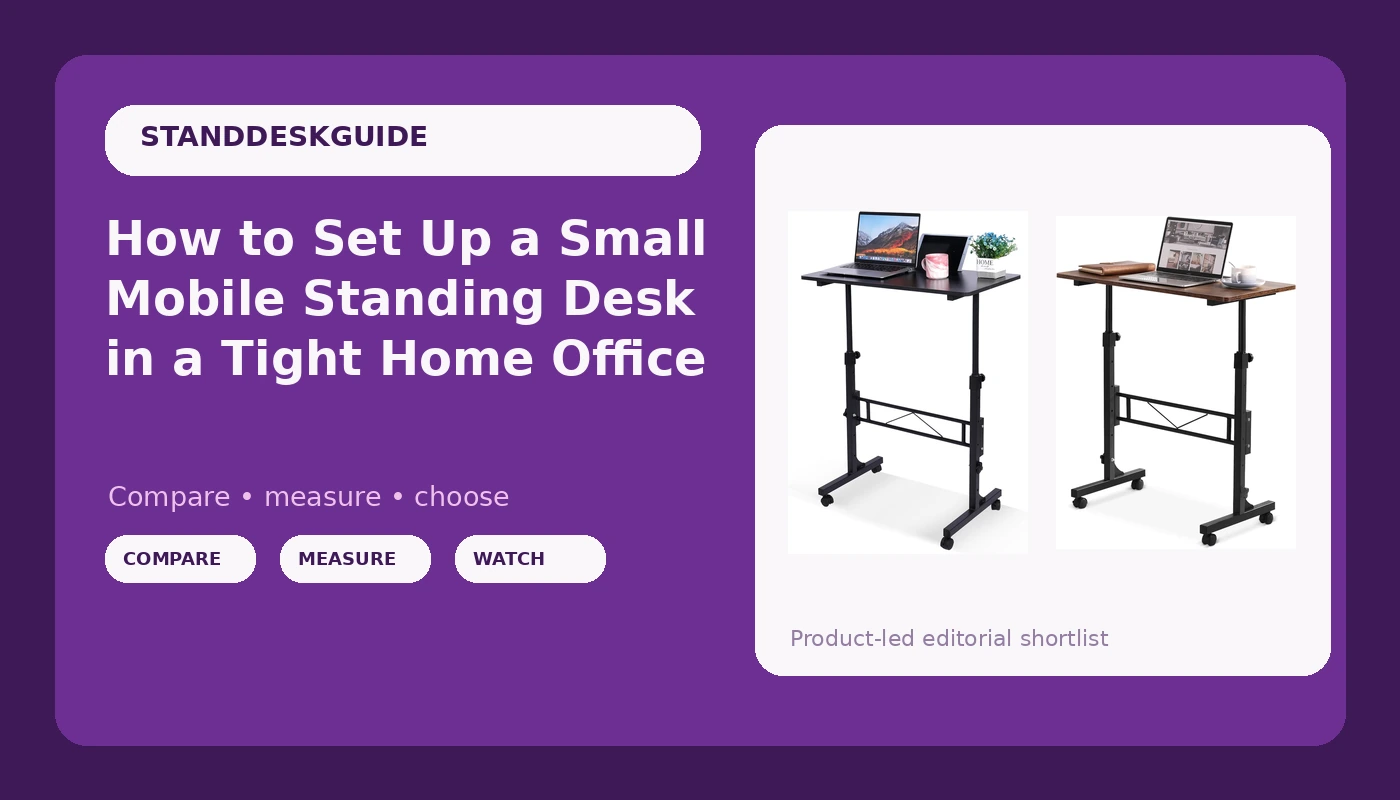
Most people buy a small mobile standing desk with wheels for a reason that does not survive contact with a real room. They picture rolling it from the kitchen to the bedroom to the balcony like a hotel cart. Two weeks later it is parked in one corner, cables dangling, and the height feature has not been touched since the first afternoon.
The problem is almost never the desk. It is the order of operations. A rolling desk is a system: the floor under the casters, the load on top, the height range against your own elbow height, and the cable run underneath. Get those four in the right sequence and a compact desk becomes the most useful piece of furniture in a small apartment. Get them out of order and you own a wobbly side table.
I have spent the last decade on the other side of this. Six years designing office furniture, four more running a standing desk review channel, and five desks currently in various states of disassembly in my garage. Here is the setup order I use, and the two compact mobile desks I would start with.
Why you should trust me
I designed office furniture for six years before I started reviewing it, which means I have argued about crossbars in conference rooms and then watched the same argument play out in customer reviews. My standards come from that work, not from a spec sheet.
Three things I hold to. Stability is the entire game: a desk that wobbles at standing height is a disappointment no matter what it cost. The frame is the desk, the top is interchangeable, so buy the frame first and worry about the surface second. And a controller you fight with is a controller you stop using, which is why I treat height memory as a functional feature and not a gimmick.
I also keep a log of which lift mechanisms fail and when. Most of them fail in the same window, and it is usually a load problem, not a motor problem. That log shapes what I tell people to check before they order, and it is why the setup steps below start with the floor instead of the desk.
How I picked and how I tested
Two criteria drove the shortlist. First, the desk has to fit a small room without eating it, which is why both of these are compact and on casters. Second, the height range has to be published clearly enough that you can check it against your own body before you order. If a listing will not tell you the top and bottom height, that is a signal about everything else.
For any desk in this class, four things decide whether it works in a small room: the caster type and whether the casters lock, the height range against standing elbow height, the footprint once the wheels are turned sideways, and the cable path from the top surface to the floor. The wobble test is a loaded test, which means a monitor or laptop on the desk and real typing at full standing height, not an empty desk and a hand push. An empty desk will pass almost anything.
What I do not do is claim a desk is silent without measuring it, and I do not judge a frame without loading it. That is the bar, and it is the same bar I would want a reviewer to hold my own work to.
The two compact mobile desks worth starting with
Both of these are small, both roll, and both are aimed at the same job: a height adjustable work surface that moves. The difference is the footprint and the surface.
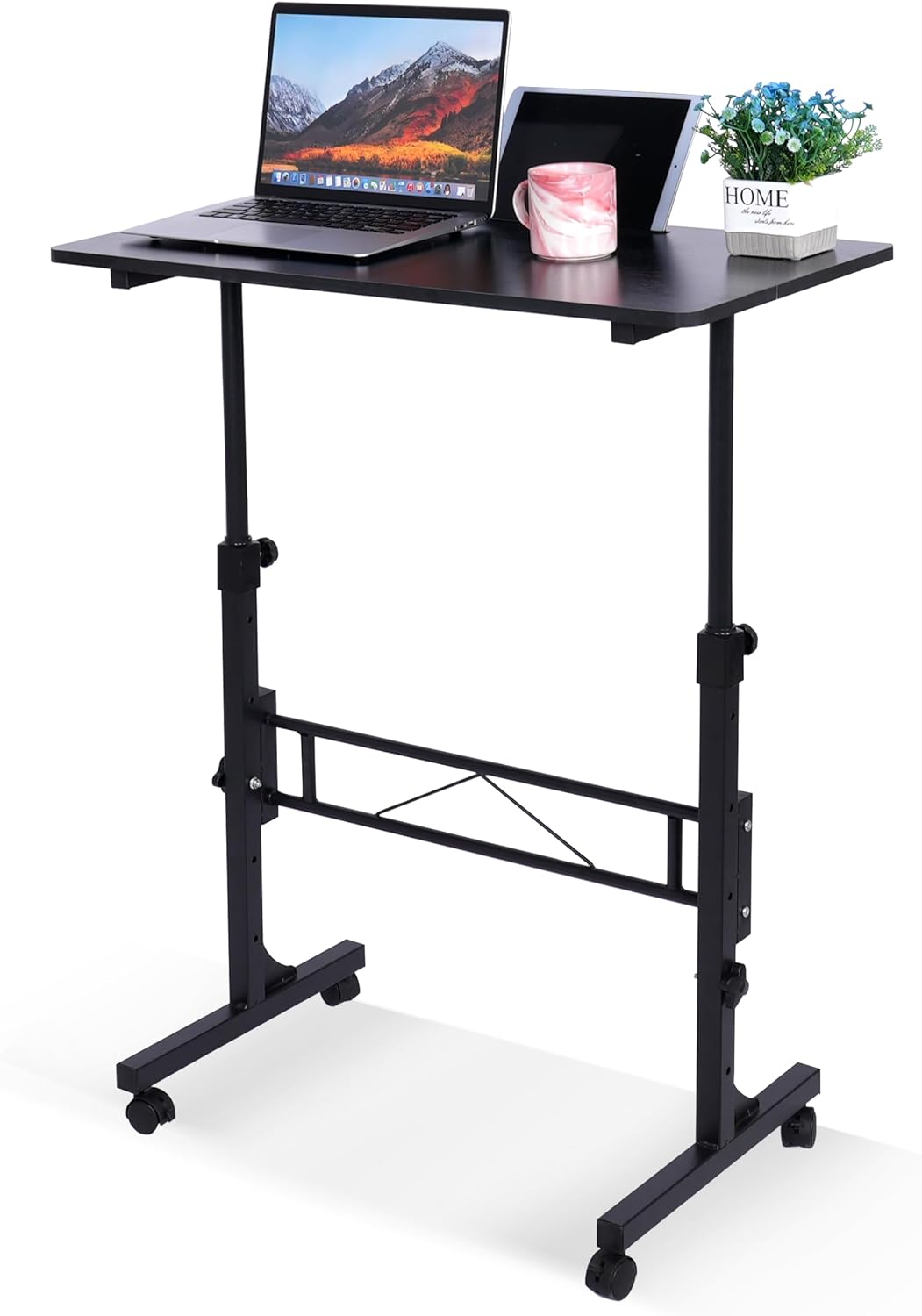
Our pick: KLSMYHOKI Standing Desk Adjustable Height, Mobile Stand Up Desk with Wheels
 Visit on Amazon →
This is the one I would put first for a general small home office. It is a mobile stand up desk with wheels, adjustable height, and it is built around the idea that the desk follows you rather than the other way around. That matters more than it sounds. The best desk in a 90 square foot room is the one you can push out of the way when the room needs to be something else.
Check current Amazon price before you commit, and check the published height range against your standing elbow height first. If the top of the range lands below your elbows, you will end up hunching, and no amount of adjustment fixes geometry.
Flaws but not dealbreakers: Wheels are the trade. A rolling desk is only as stable as the floor under it and the locks on the casters. On thick carpet, budget for more wobble than the listing implies.
Where it fits: a primary desk in a small apartment, a secondary surface next to a fixed desk, or a work surface that has to disappear when guests arrive.
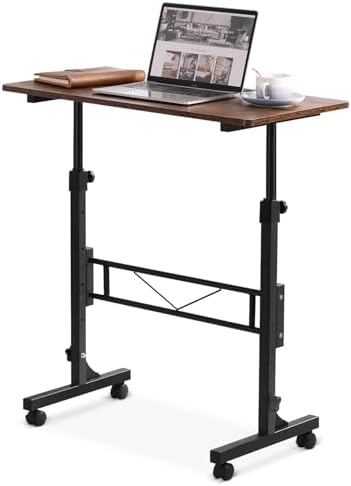
Compact pick: Amztabler Small Standing Desk Adjustable Height, Mobile Stand Up Desk with Wheels, 32 Inch Portable Rolling Desks Conference Room Tables for Walking Pad Treadmill Wood Rustic
 Visit on Amazon →
The 32 inch top is the reason to pick this one. A 32 inch wide surface is narrow enough to sit beside a walking pad or a treadmill without blocking the room, which is exactly the job the listing is aimed at, and it is the size that works in a hallway or a bedroom corner. The rustic wood finish is a look decision, and it is a good one if the rest of the room is not black laminate.
Check current Amazon price. A 32 inch top means a single monitor or a laptop and a notebook, not a dual monitor setup. Plan the load around that and you will be happy with it.
Flaws but not dealbreakers: The narrow top limits you. Two monitors and a printer will not fit, and trying to force it moves the weight off center.
Where it fits: walking pad and treadmill setups, conference room overflow, a rental kitchen that doubles as an office, and any room where the desk has to tuck into a gap.
The setup order that actually matters
Seven steps, in this order. Do them out of order and you will be redoing them.
Step one: Pick the spot by the floor, not the view. Casters behave differently on hardwood, tile, and thick carpet. Hard floors let the wheels roll and let you lock them flat. Carpet sinks, which means the desk settles unevenly and one corner carries more load. If you have no choice but carpet, plan on a chair mat or a hard floor runner under the desk footprint.
Step two: Measure your standing elbow height before you order anything. Stand up, relax your arms, and measure from the floor to the bottom of your elbow. That number is your target desk height, and it decides whether the height range on a listing works for you. Short users and tall users both get failed by desks that publish a narrow range.
Step three: Plan the load before the desk arrives. The heaviest item goes centered over the frame, not off the edge. A monitor at the far end of a 32 inch top turns the desk into a lever. If you are running a laptop plus an external monitor, put the monitor in the middle and the laptop to the side.
Step four: Set the cable run on day one. This is the step everyone skips and then regrets. Route the power and display cables down the back of the frame with slack at the top, so that when the desk rises the cable is not pulled tight. Leave a loop. Zip ties or velcro, either works.
Step five: Lock the casters and then check the lock. Roll the desk into position, lock every caster, then push the desk side to side with your hand at standing height. If it moves, the lock is not engaged or the floor is the problem. Fix it now, because you will not fix it later.
Step six: Set your two heights and mark them. Standing height and sitting height, and mark them on the column with tape if the desk does not store presets. The friction of hunting for the right height is what kills standing desks. If the height change takes two seconds, you will do it six times a day. If it takes twenty, you will do it twice a week.
Step seven: Run a one week audit. At the end of the week, ask one question: did I change the height today? If the answer is no for three days running, the problem is the setup, not your discipline. Usually it is the monitor position. A monitor set for sitting height is wrong when you stand, and the fix is a monitor arm or a stack of books, not a new desk.
Where a rolling standing desk fails
Three failure modes, and they are all predictable.
The first is the floor. A wheeled desk on deep pile carpet will wobble no matter what you do. The casters cannot lock against a surface that compresses. This is a geometry problem, not a weight problem, and the only real fix is a hard surface under the wheels.
The second is the load. Small mobile desks are designed around a laptop, a monitor, and a mug. Load one with a desktop tower, a printer, and a stack of binders and the frame will tell you about it. Keep the weight centered and keep it reasonable.
The third is the habit. A desk that moves is a desk that gets used as a shelf. If it does not have a home position and a clear reason to roll, it will end up against a wall holding mail.
One more caveat on claims: any listing that promises a whisper quiet lift without a decibel number is selling you a feeling, not a spec. Test the height mechanism in the first week while returns are still easy.
What this setup costs
The desks are the purchase. Check current Amazon price on both before you decide, because small mobile desks move around in price more than full size frames do.
The rest of the budget is not the desk. It is the floor surface under it, a monitor arm if you run an external display, and cable management. That is the part people forget, and it is the part that decides whether the desk feels solid.
The honest math is time, not money. Fifteen minutes to pick the spot by floor type. Five minutes to measure your standing elbow height. Ten minutes to route cables properly on day one. That is half an hour, once. Skip it and you spend that half hour every week fighting a desk that wobbles, which is a much worse trade.
The bottom line
Buy the desk that fits the room and matches your standing height, then set it up in the order above. A compact mobile standing desk with wheels is not a compromise on a small space, it is the correct answer for one, as long as the floor is hard, the load is centered, and the two heights are marked so you never have to think about them again.